The short version:
Professions in Battle for Azeroth are going to be reworked in the following way: You'll have a separate skill level for each expansion's content, going up to 100. The great part of this is that if you've been neglecting your professions while leveling up (or just found it hard to keep up without farming or buying materials on the auction house,) you'll get a soft reset each time you go to a new continent. The perhaps less good part is that you won't be getting skill levels that are useful for old content by doing new content.
In Legion, with few exceptions for "prestige" items like mounts and such, skill level was sort of irrelevant - you had a quest chain to learn most recipes, and you could easily take, say, your Demon Hunter, and get them skilled up from 1 entirely in Broken Isles content.
Being able to effectively mine, gather herbs, or skin at a low skill level, as well as having recipes that skilled you up quickly and effectively, made professions much less of a pain in Legion. On the flip side, because none of it was skill-based, it did mean that you would need to perform quest tasks to fill out your recipe list, and some recipes were hidden behind infuriatingly rare drop rates (I still haven't gotten by Broken Isles teleporter recipe.)
I'm curious to see how BFA handles skill levels in its future content. Presumably we'll see a Wrath-era recipe that previously required a skill of 400 will now require 25, as Wrath's profession range was originally 375-450 (or maybe 350-450, as I think they started having a catch-up overlap in Wrath.)
What this means is that you might not be able to get all your BFA recipes without crafting anything, but the fact that we're effectively all starting at Kul Tiras/Zandalar skill 1 means that new alts and old mains are going to be on even footing going in.
Catching up on professions has been a huge issue with the game since they started releasing expansions. They've done some interesting experiments to try to fix this issue - personally, teleporter notwithstanding, I've liked the way it's been handled in Legion. But this is a pretty radical redesign. It makes me think of the way that Cataclsym saw a serious rework of talent points before Mists just threw out the old system and implemented the new one.
I suspect that in the long run, professions are going to feel more or less the same, but this should make it less of a pain for your Mag'har Rogue to work on her alchemy skill while leveling up through Pandaria.
Thursday, March 22, 2018

Tuesday, March 20, 2018
Is Battle for Azeroth The Azshara Expansion?
In WoW's earlier expansions, the focus tended to revolve around a particular figure as its main antagonist. Burning Crusade focused largely on Illidan, having us face off against his allies before plunging into the Black Temple. Legion did give us a different perspective on all of this, of course, and Illidan's ultimate role is heroic, albeit very far on the anti-hero side of the scale. Wrath was all about Arthas, and Cataclysm built toward the confrontation with Deathwing.
Every expansion has a final boss, of course, but the more recent expansions have tended to be less about individuals than movements - Garrosh was the ultimate warmongering conqueror in an expansion about how imperialism could disturb the balance in existing societies. Archimonde was indicative of the ultimate fate of the Horde should it continue its aggressive ways (I'll grant this one was less obvious - I think Gul'dan would have made a better final boss for Warlords,) and Argus the Unmaker was an expression of Sargeras' plans for the universe - all the power of the Titans, but dedicated to destruction and death (though in this one as well I'd argue he was kind of a stand-in so that Blizzard can still keep a full-fledged Sargeras fight in their back pocket.)
Around the time of Wrath, prior to the announcement of Cataclysm, a few names were bandied around as possible villains for future expansions. Deathwing was, actually, one of the top characters on that list, so when the expansion was announced people weren't terribly surprised. But another figure in that tier was always Azshara.
In BFA, we know that we will fight, and presumably kill, Azshara, as she has been announced as a raid boss in the expansion. The question, however, is at what point we'll be doing so.
Take Xavius for example: Blizzard always warned players that they didn't think an Emerald Nightmare expansion would work, given how it's just a reflection of the physical world. But I think many figured they would eventually change their minds. Xavius was an established character and with the fleshing-out that characters always get when they're focused on, he might have carried an expansion. Instead, he got a rather memorable turn as the first final raid boss in Legion.
The question that I have is whether Azshara is going to go the way of Xavius or Cho'gall - established characters killed off early in an expansion - or if she will remain a major threat throughout.
Some spoilers from the Alpha to follow:
Every expansion has a final boss, of course, but the more recent expansions have tended to be less about individuals than movements - Garrosh was the ultimate warmongering conqueror in an expansion about how imperialism could disturb the balance in existing societies. Archimonde was indicative of the ultimate fate of the Horde should it continue its aggressive ways (I'll grant this one was less obvious - I think Gul'dan would have made a better final boss for Warlords,) and Argus the Unmaker was an expression of Sargeras' plans for the universe - all the power of the Titans, but dedicated to destruction and death (though in this one as well I'd argue he was kind of a stand-in so that Blizzard can still keep a full-fledged Sargeras fight in their back pocket.)
Around the time of Wrath, prior to the announcement of Cataclysm, a few names were bandied around as possible villains for future expansions. Deathwing was, actually, one of the top characters on that list, so when the expansion was announced people weren't terribly surprised. But another figure in that tier was always Azshara.
In BFA, we know that we will fight, and presumably kill, Azshara, as she has been announced as a raid boss in the expansion. The question, however, is at what point we'll be doing so.
Take Xavius for example: Blizzard always warned players that they didn't think an Emerald Nightmare expansion would work, given how it's just a reflection of the physical world. But I think many figured they would eventually change their minds. Xavius was an established character and with the fleshing-out that characters always get when they're focused on, he might have carried an expansion. Instead, he got a rather memorable turn as the first final raid boss in Legion.
The question that I have is whether Azshara is going to go the way of Xavius or Cho'gall - established characters killed off early in an expansion - or if she will remain a major threat throughout.
Some spoilers from the Alpha to follow:
Monday, March 19, 2018
Witches of Azeroth
I grew up in Massachusetts. While I lived in a suburb of Boston, relatively far (for someone from a state as geographically small as Massachusetts) from Salem, New England is an area with a kind of quintessential Halloween climate, and even though my town didn't really push witches as a tourism thing (kind of in poor taste when you think about the fact that the actual trials were basically a bunch of totally innocent people being hanged or crushed to death by angry mobs,) the swampy woods that are leafless for much of the year, generally starting around October, really fit with the spooky vibe. It didn't hurt that my mom would organize the neighborhood Halloween party at the community center up the street.
I'm saying I've always been into Halloween and kind of spooky aesthetics, is what I'm saying, which if you've read this blog you probably gathered from my preference for Worgen (despite not really playing my poor wolf-man that much) and Death Knights, and obsession over the Scourge.
Hearthstone's new expansion (which I just impulse pre-purchased) is the Witchwood, which is set in Gilneas - a place with a sort of extreme version of that New England spooky climate (Boston actually gets gorgeous in late spring and summer.) It looks to have a classic haunted woods aesthetic.
Likewise, in Battle for Azeroth, we'll be getting the zone of Drustvar, where a group of evil witches apparently employ death magic to assault the locals, and use creepy wicker-man constructs as minions. We've also discovered that Kul Tiran humans are going to be a playable allied race, with similar wicker-style beast forms (I can feel my Night Elf gradually slipping downward in terms of priority as "main druid.")
Witchcraft has had representation in Warcraft lore, but there's actually very little consistency behind it. This is actually a common theme in fantasy RPGs - one rarely finds Witch as a playable class, despite it being one of the first fantasy archetypes that people tend to learn about (if you want to talk about a fantasy property basically every American has known since at least 1939 - if not from the novels the Wizard of Oz was based on - you've got the Wicked Witch of the West as one of the most iconic film villains of all time.)
I wonder why this is, though I have some theories. For one thing, Witch often comes with a gendered connotation. Witches are typically seen as female. I don't want to get too deep in this, but there is a tendency in our patriarchal culture to find it more culturally acceptable for women to use a "male" designation than vice versa. "Warlock" is often used as a masculine version of Witch, and few seem to bat an eye at a female character being a Warlock, which some might find a male character as a Witch to be embarrassing. There's a ton to unpack there, and I'm not getting into it in this post, and while I'd also point out that historically, Witch didn't have such a gendered connotation (plenty of men in Salem were executed as witches,) I could imagine that this hesitance to use the term for a playable class as being a relic of a time when RPGs and gaming in general were a less welcoming and open place for all people (including, you know, roughly half of all people.)
But beside this issue, I also think that Witches have struggled with a too-broad, or perhaps multifaceted definition.
In the time of the Salem trials, a Witch was almost exactly what we see with Warlocks in WoW. The source of a Witch's power was entirely infernal in nature. The people in Salem of course had a dichotomy-structured worldview. There was holiness, which didn't involve any sort of magic wielded by individuals; instead, a virtuous person would trust in God to do what was right and hope for salvation after death (I realize that talking about this in the past tense is kind of odd, given that tons of people believe more or less what I just described.) The flipside of this, of course, means that magic can only be derived through pacts with the enemy of God, namely, the Devil.
However, in contemporary terms, people who refer to themselves as Witches are generally more aligned with neo-paganism, typically with a focus on connecting with nature and a divinity more in tune with natural fertility (and, I think largely as a response to the aforementioned misogyny surrounding the witch myth, generally associated with femininity.) These witches, in WoW class terms are almost certainly more closely aligned with Druids. We even see this term used in-game to refer to a kind of half-practice of Druidism - Gilnean Harvest-Witches employ druidic magic, though it's only after their transformation into Worgen that these figures were able to become full-fledged Druids.
Another candidate for Witches in Warcraft are Mages. This largely follows the Harry Potter use of the term, where Witch is simply a female term for Wizard (see "Hogwarts School of Witchcraft and Wizardry.") This suggests the more intellectual style of magical practice, but without the fiendish associations and wickedness associated with Warlocks. Mages, which could potentially be broken down into Wizards and Witches, are simply intellectuals - kind of the fantasy equivalent of physicists.
Finally, we have Shamans. In Troll culture, which is largely inspired by a mishmash of Mesoamerican and Afro-Caribbean culture, Shamans are often referred to as Witch-Doctors. Indeed, a lot of these real-world cultures helped to inspire the modern image of Witches as well. Warcraft Shamans always kind of straddle these two identities - one is very focused on the alchemical elements as their primary theme, but the other identity is perhaps more akin to real-world shamanism - namely the belief in invisible spirits that surround us all the time. Beyond Trolls, we don't often see Warcraft Shamans referred to as Witches, though I'd point out that the tier ten set is called "Frost Witch."
While never referred to as witches, the Arrokoa outcasts have a rather witch-like aesthetic in the Spires of Arak. These people employ Shadow Magic, many of them effectively Shadow Priests. One could argue that player characters who go Shadow could potentially qualify as Witches, though I'd argue this is stretching it a bit.
So that's five player classes that might fit the term.
In BFA, we'll be interacting with witches in Drustvar. Unlike these classes, however, these figures seem more like a type of creature than merely people who chose a certain type of magic. In this way, they're more akin to D&D's Hags, who play that classic fairy tale role of the evil witch (in D&D, most Hags are classified as Fey, the same creature type as sprites and pixies, which helps them fit that fairy tale feeling. WoW doesn't really have a corresponding type.)
Long, long ago, before I started this blog and would instead record ideas about WoW in a single Word document, before Wrath of the Lich King had even been announced, one of the first ideas I had for a new playable class was the Witch. At the time, a lot of classes were defined around a magic type or often a combination of two or three types - Mages were Fire, Frost, and Arcane. Warlocks were Fire and Shadow. Priests were Holy and Shadow, etc. My concept for Witches was that they'd combine Nature and Shadow (oddly, that's actually represented by Rogues now,) taking a sort of darker version of Druid magic.
I'm not entirely sure that such a class would really fit into the game as it stands now - as we've seen, Witches are kind of spread out over many classes.
Still, I think that, as both heroes and villains, this character archetype has a lot of potential in-game.
I'm saying I've always been into Halloween and kind of spooky aesthetics, is what I'm saying, which if you've read this blog you probably gathered from my preference for Worgen (despite not really playing my poor wolf-man that much) and Death Knights, and obsession over the Scourge.
Hearthstone's new expansion (which I just impulse pre-purchased) is the Witchwood, which is set in Gilneas - a place with a sort of extreme version of that New England spooky climate (Boston actually gets gorgeous in late spring and summer.) It looks to have a classic haunted woods aesthetic.
Likewise, in Battle for Azeroth, we'll be getting the zone of Drustvar, where a group of evil witches apparently employ death magic to assault the locals, and use creepy wicker-man constructs as minions. We've also discovered that Kul Tiran humans are going to be a playable allied race, with similar wicker-style beast forms (I can feel my Night Elf gradually slipping downward in terms of priority as "main druid.")
Witchcraft has had representation in Warcraft lore, but there's actually very little consistency behind it. This is actually a common theme in fantasy RPGs - one rarely finds Witch as a playable class, despite it being one of the first fantasy archetypes that people tend to learn about (if you want to talk about a fantasy property basically every American has known since at least 1939 - if not from the novels the Wizard of Oz was based on - you've got the Wicked Witch of the West as one of the most iconic film villains of all time.)
I wonder why this is, though I have some theories. For one thing, Witch often comes with a gendered connotation. Witches are typically seen as female. I don't want to get too deep in this, but there is a tendency in our patriarchal culture to find it more culturally acceptable for women to use a "male" designation than vice versa. "Warlock" is often used as a masculine version of Witch, and few seem to bat an eye at a female character being a Warlock, which some might find a male character as a Witch to be embarrassing. There's a ton to unpack there, and I'm not getting into it in this post, and while I'd also point out that historically, Witch didn't have such a gendered connotation (plenty of men in Salem were executed as witches,) I could imagine that this hesitance to use the term for a playable class as being a relic of a time when RPGs and gaming in general were a less welcoming and open place for all people (including, you know, roughly half of all people.)
But beside this issue, I also think that Witches have struggled with a too-broad, or perhaps multifaceted definition.
In the time of the Salem trials, a Witch was almost exactly what we see with Warlocks in WoW. The source of a Witch's power was entirely infernal in nature. The people in Salem of course had a dichotomy-structured worldview. There was holiness, which didn't involve any sort of magic wielded by individuals; instead, a virtuous person would trust in God to do what was right and hope for salvation after death (I realize that talking about this in the past tense is kind of odd, given that tons of people believe more or less what I just described.) The flipside of this, of course, means that magic can only be derived through pacts with the enemy of God, namely, the Devil.
However, in contemporary terms, people who refer to themselves as Witches are generally more aligned with neo-paganism, typically with a focus on connecting with nature and a divinity more in tune with natural fertility (and, I think largely as a response to the aforementioned misogyny surrounding the witch myth, generally associated with femininity.) These witches, in WoW class terms are almost certainly more closely aligned with Druids. We even see this term used in-game to refer to a kind of half-practice of Druidism - Gilnean Harvest-Witches employ druidic magic, though it's only after their transformation into Worgen that these figures were able to become full-fledged Druids.
Another candidate for Witches in Warcraft are Mages. This largely follows the Harry Potter use of the term, where Witch is simply a female term for Wizard (see "Hogwarts School of Witchcraft and Wizardry.") This suggests the more intellectual style of magical practice, but without the fiendish associations and wickedness associated with Warlocks. Mages, which could potentially be broken down into Wizards and Witches, are simply intellectuals - kind of the fantasy equivalent of physicists.
Finally, we have Shamans. In Troll culture, which is largely inspired by a mishmash of Mesoamerican and Afro-Caribbean culture, Shamans are often referred to as Witch-Doctors. Indeed, a lot of these real-world cultures helped to inspire the modern image of Witches as well. Warcraft Shamans always kind of straddle these two identities - one is very focused on the alchemical elements as their primary theme, but the other identity is perhaps more akin to real-world shamanism - namely the belief in invisible spirits that surround us all the time. Beyond Trolls, we don't often see Warcraft Shamans referred to as Witches, though I'd point out that the tier ten set is called "Frost Witch."
While never referred to as witches, the Arrokoa outcasts have a rather witch-like aesthetic in the Spires of Arak. These people employ Shadow Magic, many of them effectively Shadow Priests. One could argue that player characters who go Shadow could potentially qualify as Witches, though I'd argue this is stretching it a bit.
So that's five player classes that might fit the term.
In BFA, we'll be interacting with witches in Drustvar. Unlike these classes, however, these figures seem more like a type of creature than merely people who chose a certain type of magic. In this way, they're more akin to D&D's Hags, who play that classic fairy tale role of the evil witch (in D&D, most Hags are classified as Fey, the same creature type as sprites and pixies, which helps them fit that fairy tale feeling. WoW doesn't really have a corresponding type.)
Long, long ago, before I started this blog and would instead record ideas about WoW in a single Word document, before Wrath of the Lich King had even been announced, one of the first ideas I had for a new playable class was the Witch. At the time, a lot of classes were defined around a magic type or often a combination of two or three types - Mages were Fire, Frost, and Arcane. Warlocks were Fire and Shadow. Priests were Holy and Shadow, etc. My concept for Witches was that they'd combine Nature and Shadow (oddly, that's actually represented by Rogues now,) taking a sort of darker version of Druid magic.
I'm not entirely sure that such a class would really fit into the game as it stands now - as we've seen, Witches are kind of spread out over many classes.
Still, I think that, as both heroes and villains, this character archetype has a lot of potential in-game.
Thursday, March 15, 2018
Druid Form Images Essentially Confirm Kul Tiran Human Druids, also Kul Tiran Humans
If you thought dinosaurs were exciting (and yes, they are,) check this out:
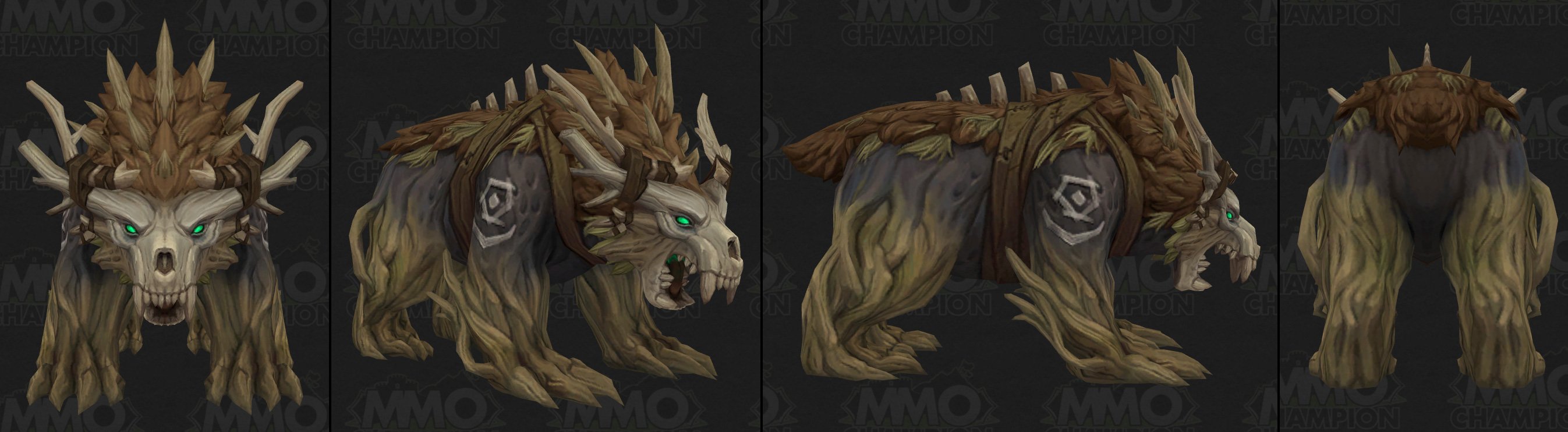 (Care of MMO-Champion.)
This simple image tells us a couple things: Given the overall shape and familiar moon-like sigil on the shoulder, this would be a Druidic bear form. The gnarled wooden appearance heavily evokes the Kul Tiras zone of Drustvar.
We can thus, with a fair degree of confidence, that this means A: Kul Tirans have a druidic tradition, which does make sense given their connection to Gilneas. While Gilnean Harvest Witches were only scratching the surface of the practice until the whole Worgen curse came along and the Night Elves started training them, it's not impossible to imagine that the humans of Kul Tiras also developed these techniques (with Zandalari and potentially standard Trolls, we're seeing Druidic traditions not immediately descendant from Malfurion's teachings.)
Of course, if Kul Tiran Human Druids are going to be a thing, that means that this more or less confirms Kul Tirans as a playable race, and likely the Alliance's fourth allied race. Especially given the existence of Mag'har Orcs, it makes sense that the Alliance would get a variant on their flagship race as well, not to mention that they also mirror the Zandalari Trolls as the dominant race on their respective continents.
Personally, I've always wanted to see a darker side of Druidism in WoW, and while Worgen certainly come a little closer to that, this goes a big step farther by making these druid forms reminiscent less of animals but of the creepy wicker-man creatures found in Drustvar.
These days when you hear pagan or druid, unless you're in a very religiously conservative community, you probably think more of hippies and new age types, but there is of course a long tradition of seeing such things as terrifying - the province of witchcraft (again, if you meet someone who calls themselves a witch these days, you might roll your eyes but you're probably not afraid that they'll actually curse you.)
But that old-fashioned view of paganism has been a great source for horror fiction, and it's something I'm pretty excited to see in Drustvar. With their creepy looks (and we haven't seen the other forms yet,) it'd be cool to find that Druids in Kul Tiras are a sort of shunned and feared part of society, much like Warlocks are for most races or Mages are for Night Elves.
And yet, the bigger takeaway in all of this is that this pretty much confirms Kul Tiran Humans as a playable race. Again, it makes a ton of sense from a lore perspective, but I wonder, then what their class options might be:
Warrior: It's harder, I think, to justify a race not having Warriors than the other way. The only time we ever had a race that couldn't was Blood Elves during BC and Wrath, but they got them during Cataclysm, so here we are. And the burly Kul Tirans are very unlikely not to have any sort of classic martial tradition.
Paladin: This is up for debate. Gilneas apparently doesn't have a Paladin tradition (that seems to have been more of a Stormwind/Lordaeron thing among humans.) Still, Kul Tiras was less isolationist than Gilneas, so it's not that hard to imagine they'd embraced it.
Death Knight: I'd argue this ought to work - Kul Tiras didn't have a huge presence in Lordaeron from the Third War through Wrath, but if we can accept that some Argual-associated Worgen could be turned, I don't think it's a stretch for some Kul Tiran members of the Alliance to be turned as well (Jaina was certainly fighting the Scourge, though to be fair she was there more in her capacity as a Dalaran Mage than Kul Tiran royalty.)
Hunter: Much like Warrior, this one's harder to justify excluding than including. And especially given that Kul Tirans are supposed to be big monster hunters, this is an obvious fit.
Shaman: The only human-like people with a real Shamanistic tradition are the Vrykul, and as burly as Kul Tirans are, they're not Vrykul. I wouldn't say no if it was offered, but I doubt this one.
Rogue: Slightly less than Warriors and Hunters, but again it's pretty hard to imagine a race that can't have stealthy assassins, and certainly with all the pirates sailing out of Kul Tiras, they've got to at least have Outlaw Rogues.
Demon Hunter: I can really only imagine them ever adding Naga, Broken Draenei, or possibly Fel Orcs as Demon Hunter races beyond the ones that already exist. Which is a shame, because I could have totally rocked a Worgen Demon Hunter.
Druid: This is kind of confirmed and of course the impetus of the post. I'm really hoping for a creepier take on Druids in a game that has historically treated them as one of the most unambiguously good-guy classes.
Monk: If they're allowing Nightborne Monks, then this isn't really about cultural traditions as much as their willingness to deal with Pandaren, so I wouldn't rule it out.
Mage: Jaina's a pretty huge precedent here, and there is some mention of a local tradition of mages on Kul Tiras that Jaina was initially sent to Dalaran in order to represent.
Warlock: Where there are Mages, it's not hard to imagine Warlocks coming as well. Kul Tiras doesn't seem to have a particularly strong holy/righteous vibe to it, so I see no reason to rule them out.
Priest: Priest is another broadly applicable class, and given the very Lovecraftian sea-priests we seem to be getting in Stormsong Valley (I'd love to see a place called Innswitch or Dunsmouth) there's clearly also some Shadow Priest stuff going on there.
This simple image tells us a couple things: Given the overall shape and familiar moon-like sigil on the shoulder, this would be a Druidic bear form. The gnarled wooden appearance heavily evokes the Kul Tiras zone of Drustvar.
We can thus, with a fair degree of confidence, that this means A: Kul Tirans have a druidic tradition, which does make sense given their connection to Gilneas. While Gilnean Harvest Witches were only scratching the surface of the practice until the whole Worgen curse came along and the Night Elves started training them, it's not impossible to imagine that the humans of Kul Tiras also developed these techniques (with Zandalari and potentially standard Trolls, we're seeing Druidic traditions not immediately descendant from Malfurion's teachings.)
Of course, if Kul Tiran Human Druids are going to be a thing, that means that this more or less confirms Kul Tirans as a playable race, and likely the Alliance's fourth allied race. Especially given the existence of Mag'har Orcs, it makes sense that the Alliance would get a variant on their flagship race as well, not to mention that they also mirror the Zandalari Trolls as the dominant race on their respective continents.
Personally, I've always wanted to see a darker side of Druidism in WoW, and while Worgen certainly come a little closer to that, this goes a big step farther by making these druid forms reminiscent less of animals but of the creepy wicker-man creatures found in Drustvar.
These days when you hear pagan or druid, unless you're in a very religiously conservative community, you probably think more of hippies and new age types, but there is of course a long tradition of seeing such things as terrifying - the province of witchcraft (again, if you meet someone who calls themselves a witch these days, you might roll your eyes but you're probably not afraid that they'll actually curse you.)
But that old-fashioned view of paganism has been a great source for horror fiction, and it's something I'm pretty excited to see in Drustvar. With their creepy looks (and we haven't seen the other forms yet,) it'd be cool to find that Druids in Kul Tiras are a sort of shunned and feared part of society, much like Warlocks are for most races or Mages are for Night Elves.
And yet, the bigger takeaway in all of this is that this pretty much confirms Kul Tiran Humans as a playable race. Again, it makes a ton of sense from a lore perspective, but I wonder, then what their class options might be:
Warrior: It's harder, I think, to justify a race not having Warriors than the other way. The only time we ever had a race that couldn't was Blood Elves during BC and Wrath, but they got them during Cataclysm, so here we are. And the burly Kul Tirans are very unlikely not to have any sort of classic martial tradition.
Paladin: This is up for debate. Gilneas apparently doesn't have a Paladin tradition (that seems to have been more of a Stormwind/Lordaeron thing among humans.) Still, Kul Tiras was less isolationist than Gilneas, so it's not that hard to imagine they'd embraced it.
Death Knight: I'd argue this ought to work - Kul Tiras didn't have a huge presence in Lordaeron from the Third War through Wrath, but if we can accept that some Argual-associated Worgen could be turned, I don't think it's a stretch for some Kul Tiran members of the Alliance to be turned as well (Jaina was certainly fighting the Scourge, though to be fair she was there more in her capacity as a Dalaran Mage than Kul Tiran royalty.)
Hunter: Much like Warrior, this one's harder to justify excluding than including. And especially given that Kul Tirans are supposed to be big monster hunters, this is an obvious fit.
Shaman: The only human-like people with a real Shamanistic tradition are the Vrykul, and as burly as Kul Tirans are, they're not Vrykul. I wouldn't say no if it was offered, but I doubt this one.
Rogue: Slightly less than Warriors and Hunters, but again it's pretty hard to imagine a race that can't have stealthy assassins, and certainly with all the pirates sailing out of Kul Tiras, they've got to at least have Outlaw Rogues.
Demon Hunter: I can really only imagine them ever adding Naga, Broken Draenei, or possibly Fel Orcs as Demon Hunter races beyond the ones that already exist. Which is a shame, because I could have totally rocked a Worgen Demon Hunter.
Druid: This is kind of confirmed and of course the impetus of the post. I'm really hoping for a creepier take on Druids in a game that has historically treated them as one of the most unambiguously good-guy classes.
Monk: If they're allowing Nightborne Monks, then this isn't really about cultural traditions as much as their willingness to deal with Pandaren, so I wouldn't rule it out.
Mage: Jaina's a pretty huge precedent here, and there is some mention of a local tradition of mages on Kul Tiras that Jaina was initially sent to Dalaran in order to represent.
Warlock: Where there are Mages, it's not hard to imagine Warlocks coming as well. Kul Tiras doesn't seem to have a particularly strong holy/righteous vibe to it, so I see no reason to rule them out.
Priest: Priest is another broadly applicable class, and given the very Lovecraftian sea-priests we seem to be getting in Stormsong Valley (I'd love to see a place called Innswitch or Dunsmouth) there's clearly also some Shadow Priest stuff going on there.
Wednesday, March 14, 2018
Allied Races versus New Races
One thing that's gotten a lot of coverage in the Battle for Azeroth alpha is the fact that the Vulpera, a race of fox-people who seem to primarily live in the desert of Voldun on Zandalar, apparently have about as much customization options as a playable race, with different fur colors, facial features, and such. It's gotten people to speculate that they could become an Allied race, though Blizzard for now insists that it's just part of a new method for dealing with NPC races like Naga or Vrykul to allow for broad variation.
One thing I think distinguishes them as well is that they'd technically not be an Allied race.
Much like Hero Class, Allied Race is kind of a funny thing, suggesting something broad but meaning something specific (Hero Class, for example, is ironic given that its two examples are Death Knights and Demon Hunters, making it closer to Villain Class.) Allied Races have come in a larger group than typical playable races because they're ultimately not as novel: none of the Allied Races are entirely new. When the Draenei were introduced in Burning Crusade, there was nothing even remotely like them already available. But the Lightforged don't require all that much more establishment of background or visual design than their BC precedents.
I think we can safely define Allied Race as a variation on an existing race. Clearly, they can do radical things like have them swap factions (Void Elves being the Alliance Blood Elf variant and Nightborne being the Horde Night Elf variant,) but fundamentally they're not going all the way back to the basics and building, for example, a new 3D skeleton.
The question, then, is what we might expect of entirely new races.
For example, especially after Warlords of Draenor, I've often thought that adding Arrakoa as a playable race would be really cool. I've had similar thoughts about the Vrykul, Naga, Ogres, and Broken Draenei. Only the latter of these would really make sense as an Allied Race (in BC, their models were actually based off the Tauren, though the Argus variants, which have an entirely different origin story, seem more similar to standard Draenei in posture and body structure.)
Allied Races come with some interesting new features: they start at level 20, meaning they're never in that slow, mount-less period (though the heirloom motorcycle has given anyone with a high-level alt a relatively easy way to get their new characters around.) They also have the heritage armor, which encourages you to level up at least one of each race the old fashioned way.
I suspect that the only "new character incentives" we'll get in BFA will be Allied Races - it looks as if we're getting four per faction - but in future expansions, if we see entirely new races, is it possible we'd see similar features?
The starting at level 20 feature is probably going to be just Allied Races - it's mostly there to paper over the fact that they don't really have their own starting zones, which tend to tell stories that are specific to the given race (though I'd argue that everything from Tirisfal through Hillsbrad, or even through Eastern Plaguelands is pretty Forsaken-heavy story.) An entirely new race would presumably at least get a Cataclysm/Mists-style starting zone taking them to level 12-15.
I could see Heritage Armor being a thing for standard new races as well, though I wonder what the statistics will be after a few months regarding how many people leveled all the way for this cosmetic reward.
Allied Races seem like a relatively quick and easy way to pump out new playable races, and also allows for variations that would not really be big enough to justify entirely new races. I think we're unlikely to see new races in the expansion that follows BFA, though it's also possible that Allied Races will make such an addition something that does not require a whole expansion to justify.
One thing I think distinguishes them as well is that they'd technically not be an Allied race.
Much like Hero Class, Allied Race is kind of a funny thing, suggesting something broad but meaning something specific (Hero Class, for example, is ironic given that its two examples are Death Knights and Demon Hunters, making it closer to Villain Class.) Allied Races have come in a larger group than typical playable races because they're ultimately not as novel: none of the Allied Races are entirely new. When the Draenei were introduced in Burning Crusade, there was nothing even remotely like them already available. But the Lightforged don't require all that much more establishment of background or visual design than their BC precedents.
I think we can safely define Allied Race as a variation on an existing race. Clearly, they can do radical things like have them swap factions (Void Elves being the Alliance Blood Elf variant and Nightborne being the Horde Night Elf variant,) but fundamentally they're not going all the way back to the basics and building, for example, a new 3D skeleton.
The question, then, is what we might expect of entirely new races.
For example, especially after Warlords of Draenor, I've often thought that adding Arrakoa as a playable race would be really cool. I've had similar thoughts about the Vrykul, Naga, Ogres, and Broken Draenei. Only the latter of these would really make sense as an Allied Race (in BC, their models were actually based off the Tauren, though the Argus variants, which have an entirely different origin story, seem more similar to standard Draenei in posture and body structure.)
Allied Races come with some interesting new features: they start at level 20, meaning they're never in that slow, mount-less period (though the heirloom motorcycle has given anyone with a high-level alt a relatively easy way to get their new characters around.) They also have the heritage armor, which encourages you to level up at least one of each race the old fashioned way.
I suspect that the only "new character incentives" we'll get in BFA will be Allied Races - it looks as if we're getting four per faction - but in future expansions, if we see entirely new races, is it possible we'd see similar features?
The starting at level 20 feature is probably going to be just Allied Races - it's mostly there to paper over the fact that they don't really have their own starting zones, which tend to tell stories that are specific to the given race (though I'd argue that everything from Tirisfal through Hillsbrad, or even through Eastern Plaguelands is pretty Forsaken-heavy story.) An entirely new race would presumably at least get a Cataclysm/Mists-style starting zone taking them to level 12-15.
I could see Heritage Armor being a thing for standard new races as well, though I wonder what the statistics will be after a few months regarding how many people leveled all the way for this cosmetic reward.
Allied Races seem like a relatively quick and easy way to pump out new playable races, and also allows for variations that would not really be big enough to justify entirely new races. I think we're unlikely to see new races in the expansion that follows BFA, though it's also possible that Allied Races will make such an addition something that does not require a whole expansion to justify.
Monday, March 12, 2018
Suramar and the Max-Level Zone
One of the biggest successes in Legion, an expansion I think I'm just going to come out and say has been WoW's best (not that it's flawless, of course, but what is?) is the level-scaling feature. It turned out so obviously well that they went back and applied the feature to the entire leveling experience, and while there are some kinks they'll need to keep working out of that system, having now leveled up one Allied Race character and another one coming soon (he's 103 now I think) I can say that it makes the experience of questing and leveling a lot more enjoyable.
One of the big benefits of the system is that at level 110, all of the Broken Isles are effectively max-level zones. The developers were not forced to sequester little sub-zones that leveling characters would be forced to avoid and max-level characters would swiftly get bored of (like Warlords' daily quest areas,) instead everything is available.
But Suramar, the Broken Isles' southern central zone, was different. Unlike the others, it did not scale to level: you merely went there only after hitting 110.
That's not unprecedented, of course. Max-level zones have existed since the Isle of Quel'danas. But typically they're added later in the expansion. The only real precedent for Suramar was in Mists of Pandaria: the Vale of Eternal Blossoms (Tanaan Jungle could have counted if we had had access to it beyond the short intro quests in 6.0. It was technically there, but you couldn't go in.)
Here's the big difference, and indeed the difference between all other max-level zones and Suramar. In the past, max-level zones have all been about repeatable content. The Broken Shore, released in 7.2, is a great example (though again, it's a bit odd in that you could technically go there prior to the patch, both in the expansion-starting scenario and even just once you were in the isles, though there was not really any content beyond a ton of boss-level enemies in that latter form.) While there were story quests in a lot of max-level zones, such as the Vale of Eternal Blossoms, Suramar made those quests the primary focus.
Essentially, the richness you get from the story in a leveling zone is something you typically don't get in a max-level zone. I'm going to harp on the Broken Shore again by pointing out that its "story" quests were really only there to introduce concepts for the zone - there was almost nothing that actually furthered the plot of delving into the Tomb of Sargeras beyond, you know, actually doing it.
Suramar, on the other hand, had a complex narrative - one that was doubled in 7.1. You literally built a rebellion starting with just one other person, eventually taking back the city. And while Suramar City was clearly the main focus of the zone, there was also a ton of stuff outside the city that felt just as full and fleshed out as any quest chain in a leveling zone.
RPGs are, at their basic level, story-based games, and WoW often gets caught up in the MMO side of things to the extent that story takes a back seat. But as someone who's always excited to find more story, it was a joy to have an interesting plot to quest through even after I'd started putting together by badass raid gear.
What I wonder about is if Suramar will provide the model going forward. The Broken Shore was far more like earlier models, and while Argus had more of a plot, it was still more of a prerequisite to unlock your world quests (I was disappointed that Antoran Wastes, the most "final part" part of Argus had almost no proper quests.)
In Battle for Azeroth, we'll effectively be getting three max-level zones at the start in the form of the other faction's continent. I'm very excited about the fact that leveling a Horde character will be an entirely different experience from leveling an Alliance one. But I also wonder how much plot we'll get invading the other side's territory. I could imagine that we'll just get a short series of quests to establish a foothold and then we'll have a bunch of world quests, but I hope that we'll get a chance to really explore the plot and characters of the setting from this different perspective.
One of the big benefits of the system is that at level 110, all of the Broken Isles are effectively max-level zones. The developers were not forced to sequester little sub-zones that leveling characters would be forced to avoid and max-level characters would swiftly get bored of (like Warlords' daily quest areas,) instead everything is available.
But Suramar, the Broken Isles' southern central zone, was different. Unlike the others, it did not scale to level: you merely went there only after hitting 110.
That's not unprecedented, of course. Max-level zones have existed since the Isle of Quel'danas. But typically they're added later in the expansion. The only real precedent for Suramar was in Mists of Pandaria: the Vale of Eternal Blossoms (Tanaan Jungle could have counted if we had had access to it beyond the short intro quests in 6.0. It was technically there, but you couldn't go in.)
Here's the big difference, and indeed the difference between all other max-level zones and Suramar. In the past, max-level zones have all been about repeatable content. The Broken Shore, released in 7.2, is a great example (though again, it's a bit odd in that you could technically go there prior to the patch, both in the expansion-starting scenario and even just once you were in the isles, though there was not really any content beyond a ton of boss-level enemies in that latter form.) While there were story quests in a lot of max-level zones, such as the Vale of Eternal Blossoms, Suramar made those quests the primary focus.
Essentially, the richness you get from the story in a leveling zone is something you typically don't get in a max-level zone. I'm going to harp on the Broken Shore again by pointing out that its "story" quests were really only there to introduce concepts for the zone - there was almost nothing that actually furthered the plot of delving into the Tomb of Sargeras beyond, you know, actually doing it.
Suramar, on the other hand, had a complex narrative - one that was doubled in 7.1. You literally built a rebellion starting with just one other person, eventually taking back the city. And while Suramar City was clearly the main focus of the zone, there was also a ton of stuff outside the city that felt just as full and fleshed out as any quest chain in a leveling zone.
RPGs are, at their basic level, story-based games, and WoW often gets caught up in the MMO side of things to the extent that story takes a back seat. But as someone who's always excited to find more story, it was a joy to have an interesting plot to quest through even after I'd started putting together by badass raid gear.
What I wonder about is if Suramar will provide the model going forward. The Broken Shore was far more like earlier models, and while Argus had more of a plot, it was still more of a prerequisite to unlock your world quests (I was disappointed that Antoran Wastes, the most "final part" part of Argus had almost no proper quests.)
In Battle for Azeroth, we'll effectively be getting three max-level zones at the start in the form of the other faction's continent. I'm very excited about the fact that leveling a Horde character will be an entirely different experience from leveling an Alliance one. But I also wonder how much plot we'll get invading the other side's territory. I could imagine that we'll just get a short series of quests to establish a foothold and then we'll have a bunch of world quests, but I hope that we'll get a chance to really explore the plot and characters of the setting from this different perspective.
Saturday, March 10, 2018
Kul Tirans and Druidism
With the (technically not officially confirmed, but definitely confirmed through datamining) addition of Mag'har Orcs as the Horde's fourth allied race, there's a fair amount of speculation around the notion that the Alliance could get Kul Tiran humans.
First off, this would balance the ratio of Orcs and Humans (though you could argue that Worgen and Undead are also kind of human as well,) which is kind of a theme in Warcraft. It would also make the Horde's courting of the Zandalari by going to Zandalar kind of balanced with the Alliance truly integrating (re-integrating, really) Kul Tiras. The only reason why you might not think of this is if you were to assume that the general playable race of "Human" covers all of humanity. But the Allied Races of course are all about respecting the different history and aesthetics of different branches of races, and someone from Kul Tiras is going to have a very different history than someone from Stormwind (one thing that doesn't come up often is how most humans from Stormwind probably spent a long time in exile after the First War.)
On top of that, Blizzard has gone out of its way to give Kul Tirans a slightly different physiology - it doesn't look universal - some NPCs look like your standard humans - but there are plenty of extra-burly characters (also some extra-scrawny) that have been showcased in Kul Tiras.
So I think the probability of Kul Tirans being the fourth Alliance allied race is pretty high.
On top of that, however, is a rumor that they might get Druids.
Druids are one of those classes in WoW that are much more limited. Unlike Warriors or Mages, Druidism has historically been considered part of a specific tradition, only practiced in a few cultures. In Vanilla, only one race per faction could be Druids. I suspect this was in part because they didn't want to have to make a ton of animal forms for every race, but as their ambitions and certainly resources have grown, they have brought forth a lot of new Druids.
And while the Highmountain druids mostly just used the Tauren druid forms, adding moose antlers and changing the travel forms, we can see that with the Zandalari they're going in a radically different direction, even making the "Bear," "Cat," and "Moonkin" forms into entirely different animals (everyone's a dinosaur!)
So how might Kul Tirans be connected to Druidism?
Well, Kul Tiras was founded originally by Gilneans who sailed south to the island from their old country (fitting, as Gilneas is probably the second-most naval-oriented human nation.) Gilneas, perhaps owing to the druidic forest in the south that corresponded to the one in the Emerald Dream where the original Night Elf Worgen were imprisoned, had a tradition of Harvest Witches, who would bless the crops and draw forth a healthy harvest. Their magic didn't really go much beyond that, but these Harvest Witches who fell to the Worgen curse found that their connection with nature combined with the training of the Night Elves allowed them to become full-fledged Druids.
Is it possible that they might have developed Druidism on their own?
There's a question to be asked about the racial restriction on Druidism: is it purely cultural, or is it physiological?
Because there's actually one big distinction that all the Druid races, except the Worgen, share: They're not Titanforged.
Trolls were the original humanoid race on Azeroth (probably - it could have been Furbolgs or one of the nonplayable races.) As far as we know, the Trolls were not created - they simply evolved as organic life, perhaps from elementals like the Proto-drakes or simply from some earlier creatures. Night Elves came to be after a group of Trolls settled around the Well of Eternity. Similarly, the Tauren were Yaungol - another presumably naturally-evolved race - who were likewise transformed by the Well (though less dramatically, I'd say.) The Highmountain are of course just a group of Tauren whose ancestor, Huln, was blessed by Cenarius.
And Worgen are afflicted with a curse that effectively forces them into a druidic shapeshift form - a curse that wasn't ever intended as a curse, just a druidic practice that got out of control.
So the question is: barring some kind of forced Druidic connection like the Worgen, are artificial creations like humans incapable of connecting with nature enough to be Druids?
This question might have been simpler to answer before we know that Azeroth was a nascent Titan. At this point, it's clear that every playable race has a Titanic connection - there are the Titanforged descendants like Humans and Dwarves, the kinda-sorta Titanforged Orcs, and all the others evolved on planets with a Titan Soul in the center. So perhaps the distinction between Titanforged and naturally-evolved races is not so profound. We know of two examples of races with radically different histories producing offspring - Orc and Draenei have produced at least two hybrids: Garona and Lantressor. Likewise, there's a long history of half-elves with ancestry from both human lands and Quel'thalas (Alodi and Arator being examples.) If these people are so widely distinct (being from different planets even) and yet are still able to reproduce, one has to imagine that the physiological differences are really only surface-level, and thus probably not enough to bar the use of any particular magic.
So it's probably more cultural, and that to me says that there's nothing preventing a culture from developing a tradition on its own.
Troll Druids, and especially Zandalari Troll Druids, seem to have developed their Druidic tradition independent of the Cenarion Circle, based more around their connection to the Loa. Is it possible then that the humans of Kul Tiras discovered their own form of Druidic magic, perhaps extrapolating from the nature magic of their Harvest Witches - a tradition they likely carried with them from Gilneas?
Time will tell.
First off, this would balance the ratio of Orcs and Humans (though you could argue that Worgen and Undead are also kind of human as well,) which is kind of a theme in Warcraft. It would also make the Horde's courting of the Zandalari by going to Zandalar kind of balanced with the Alliance truly integrating (re-integrating, really) Kul Tiras. The only reason why you might not think of this is if you were to assume that the general playable race of "Human" covers all of humanity. But the Allied Races of course are all about respecting the different history and aesthetics of different branches of races, and someone from Kul Tiras is going to have a very different history than someone from Stormwind (one thing that doesn't come up often is how most humans from Stormwind probably spent a long time in exile after the First War.)
On top of that, Blizzard has gone out of its way to give Kul Tirans a slightly different physiology - it doesn't look universal - some NPCs look like your standard humans - but there are plenty of extra-burly characters (also some extra-scrawny) that have been showcased in Kul Tiras.
So I think the probability of Kul Tirans being the fourth Alliance allied race is pretty high.
On top of that, however, is a rumor that they might get Druids.
Druids are one of those classes in WoW that are much more limited. Unlike Warriors or Mages, Druidism has historically been considered part of a specific tradition, only practiced in a few cultures. In Vanilla, only one race per faction could be Druids. I suspect this was in part because they didn't want to have to make a ton of animal forms for every race, but as their ambitions and certainly resources have grown, they have brought forth a lot of new Druids.
And while the Highmountain druids mostly just used the Tauren druid forms, adding moose antlers and changing the travel forms, we can see that with the Zandalari they're going in a radically different direction, even making the "Bear," "Cat," and "Moonkin" forms into entirely different animals (everyone's a dinosaur!)
So how might Kul Tirans be connected to Druidism?
Well, Kul Tiras was founded originally by Gilneans who sailed south to the island from their old country (fitting, as Gilneas is probably the second-most naval-oriented human nation.) Gilneas, perhaps owing to the druidic forest in the south that corresponded to the one in the Emerald Dream where the original Night Elf Worgen were imprisoned, had a tradition of Harvest Witches, who would bless the crops and draw forth a healthy harvest. Their magic didn't really go much beyond that, but these Harvest Witches who fell to the Worgen curse found that their connection with nature combined with the training of the Night Elves allowed them to become full-fledged Druids.
Is it possible that they might have developed Druidism on their own?
There's a question to be asked about the racial restriction on Druidism: is it purely cultural, or is it physiological?
Because there's actually one big distinction that all the Druid races, except the Worgen, share: They're not Titanforged.
Trolls were the original humanoid race on Azeroth (probably - it could have been Furbolgs or one of the nonplayable races.) As far as we know, the Trolls were not created - they simply evolved as organic life, perhaps from elementals like the Proto-drakes or simply from some earlier creatures. Night Elves came to be after a group of Trolls settled around the Well of Eternity. Similarly, the Tauren were Yaungol - another presumably naturally-evolved race - who were likewise transformed by the Well (though less dramatically, I'd say.) The Highmountain are of course just a group of Tauren whose ancestor, Huln, was blessed by Cenarius.
And Worgen are afflicted with a curse that effectively forces them into a druidic shapeshift form - a curse that wasn't ever intended as a curse, just a druidic practice that got out of control.
So the question is: barring some kind of forced Druidic connection like the Worgen, are artificial creations like humans incapable of connecting with nature enough to be Druids?
This question might have been simpler to answer before we know that Azeroth was a nascent Titan. At this point, it's clear that every playable race has a Titanic connection - there are the Titanforged descendants like Humans and Dwarves, the kinda-sorta Titanforged Orcs, and all the others evolved on planets with a Titan Soul in the center. So perhaps the distinction between Titanforged and naturally-evolved races is not so profound. We know of two examples of races with radically different histories producing offspring - Orc and Draenei have produced at least two hybrids: Garona and Lantressor. Likewise, there's a long history of half-elves with ancestry from both human lands and Quel'thalas (Alodi and Arator being examples.) If these people are so widely distinct (being from different planets even) and yet are still able to reproduce, one has to imagine that the physiological differences are really only surface-level, and thus probably not enough to bar the use of any particular magic.
So it's probably more cultural, and that to me says that there's nothing preventing a culture from developing a tradition on its own.
Troll Druids, and especially Zandalari Troll Druids, seem to have developed their Druidic tradition independent of the Cenarion Circle, based more around their connection to the Loa. Is it possible then that the humans of Kul Tiras discovered their own form of Druidic magic, perhaps extrapolating from the nature magic of their Harvest Witches - a tradition they likely carried with them from Gilneas?
Time will tell.
Subscribe to:
Posts (Atom)