Thursday, April 29, 2021

Dystopia and Ravenloft

(Just a little content warning here: dystopian fiction is often a tool to approach troubling aspects of human experience in a new context - by giving us a fictional, speculative world, we can perhaps shed some of our preconceptions, but it's rare that a work of this genre is pure speculation. They're also often Rorschach tests, in which people will often see those they disagree with politically as representing the closer equivalent to the powerful within a dystopian regime. But the genre remains a potent one.)

Dystopian fiction is a pretty popular genre. In the 20th Century, we had novels like Aldous Huxley's Brave New World and George Orwell's 1984 (the book more than any other that created the adjective "Orwellian," though Animal Farm deserves credit here as well,) up to the massive demand for Young Adult fiction around ten years ago sparked by the popularity of The Hunger Games.

One thing that you'll notice with this genre is that they tend toward the science fiction end of the speculative fiction spectrum. But I don't think that dystopian fiction need be confined to that side.

Fantasy stories are filled with evil empires, usually a conquering force that has deposed the familiar order of an earlier regime (which is typically cast as better) and that the heroes must fight against. The Empire in the Star Wars series is a totalitarian and dystopian regime, led in accordance with the Dark Side of the Force.

But genre-wise, Star Wars isn't really dystopian fiction. While a lot of people argue it's a Western, I don't think that's true either (even if Tatooine serves as the interplanetary equivalent of the western frontier, I think Star Wars is really just high fantasy in sci-fi drag).

I think that dystopian fiction, in order to qualify, needs to convey the sense of oppression that the protagonists endure as part of a society built to break them. In fact, most dystopian fiction is filled with downer endings, where the heroes fail not only to upend the system, but to even survive it.

While Brave New World pre-dates it, 1984 is really the quintessential dystopian story. The world of 1984 was inspired by Stalinist Russia, but while the USSR at least claimed to be working for the betterment of its citizens, promising a perpetually-delayed socialist utopia, Orwell's Oceania is seemingly cruelty and oppression for oppression's sake.

In that sense, I think that the most dystopian possible setting in D&D would be the Nine Hells. It's literally the plane that blends law and evil in equal parts. While the Hells (or Baator if you're old school/still worried about the Satanic Panic) has to serve a few inspirations, and thus also wants to work in Dante's Inferno and a lot of Christian ideas about the actual hell that a lot of Christians literally believe in, I think that it makes the most sense to portray it as the ultimate Orwellian dystopia. There are elements of that, for sure - I don't remember where, but I think that maybe in the DMG they describe the plane having countless imps whose job is simply to watch everything and report back to the archdevils and ultimately Asmodeus.

Dystopian fiction I tend to think of as the brutal, totalitarian regime kind of "world I don't want to live in" while post-apocalyptic fiction (the quintessential example being Mad Max, or rather the Mad Max sequels, because the first one is weirdly pre-apocalyptic) is what I think a chaotic evil world situation would be like - basically, the Hells are 1984 while the Abyss is Mad Max.

Dystopian fiction actually comes in a fairly wide variety of flavors and styles, though, because ultimately the genre is about exploring problems the author sees in society and taking them to a logical extreme that leads to dehumanization and misery. Brave New World imagines a society that is literally drugged into complacency, allowing the most privileged members of society to lead meaninglessly hedonistic lives at the expense of an exploited and engineered underclass. 1984 is about a society in which any element of human pleasure and reason is stamped out, where the entire society is built around brainwashing, surveillance, and gaslighting to break down trust between individuals. The Hunger Games is about dehumanizing the working class to entertain the elite while inflicting misery on them to keep them from rising up.

Half-Life 2, the 2004 video game, does a remarkable job of tossing the player character, Gordon Freeman, into an Earth that has been conquered by an extra-dimensional alien empire, which is treating the entire planet and its human population as a resource to be extracted and used.

So, what about in Ravenloft?

Each domain in Ravenloft is actually pretty ripe for dystopia. The very structure of it lends itself well to dystopian elements. First off, you have the Darklords. While the Darklord of each domain is taken there and locked away by the Dark Powers as some kind of punishment, the world itself conspires to make the region supernaturally miserable. The Darklord, thus, is always left in a state of frustrated goals - like Sisyphus, they are forced to remain at a task they are doomed to fail.

But aside from their inability to succeed in the thing they most want, they are also given near-absolute power within their realm. The Dark Powers might be thought of as good for removing such wicked individuals from the Prime Material Plane (though why they haven't scooped up Acererak is beyond me) except that the other poor souls caught within these domains are left to suffer under the oppressive rule of the tyrants.

I'll confess that I haven't read through all the bios in by 2nd Edition pdf of the Ravenloft setting book, and will probably just wait until next month when I can go through Van Richten's Guide to Ravenloft to get the updated versions. But having read Curse of Strahd years ago and now playing in it, it's interesting to consider to what extent it's dystopian.

Certainly, there's an oppressive atmosphere throughout Barovia. Everything is touched by Strahd's evil. But I don't know that I'd say it has the same degree of totalitarian oppression you'd expect from a true dystopian setting.

Strahd's effect on Barovia is partially supernatural, but I think to a large extent the simple fact that he's there and essentially unkillable has made the citizens of Ravenloft act in more dystopian ways. Vallaki has its enforced celebrations that sap the energy of an already exhausted citizenry. The solutions proposed by the Abbot in Krezk are totally crazy.

I think we could build a Ravenloft domain that functions more like a classic dystopian story.

First off, many of these take place in urban environments. Freedom is usually one of the main victims of a dystopian setting (again, law + evil generally means no to freedom) and freedom is often represented by nature, which tends to be harder to come by in urban environments by definition. A domain of dread that is just one city (or even just a part of a city that was swallowed by the mists) would be a good place to start.

Next, there's dehumanization and isolation. This can happen either to an exploited underclass or the entire society, but any dystopia is going to have some system that is typically violently enforced to keep people from living ordinary lives. This can be achieved by breaking up family units and discouraging the building of friendships. Something in this society is built to make its citizens feel isolated - an individual can't stand up to a despotic regime alone, after all.

Then there's enforcement. The term "police state" is synonymous with totalitarianism, because it's a society in which the main representation of the state is its police - in other words, enforcers of order who are invested with the right to commit violence on the part of the state. While a healthy, functioning society has a government that provides services that benefit its citizens, a dystopia is one in which the only thing the government provides is violence.

Enforcement in a dystopia is arbitrary, but also common enough that the normal citizen will fear it. A member of that enforcement has every right to be brutal and violent to a citizen by their own discretion, and will sometimes make an example for no reason at all, to ensure that citizens are all compliant and unlikely to "give them a reason" to use force.

But who does the enforcing?

In a fantasy world like Ravenloft, it'd be easy to simply say that all the enforcers of this system are just monsters - inhuman, supernaturally cruel. But one of the creepiest aspects of dystopian fiction (and real totalitarian regimes) is that the lowest-level enforcers are typically recruited from among the oppressed. By creating a state of general misery, the dystopian regime creates the perfect recruiting tool - serve us and your status will be elevated. The regime doesn't even need to give them something as good as what existed prior to the takeover, as long as it's better than the typical civilian's life.

Finally, we have hierarchy.  While it varies from story to story, oftentimes the actual figures in power within a dystopia remain shrouded in mystery. While 1984 has the propaganda tool of Big Brother, he's really more equivalent to Uncle Sam than an actual person. In the Half-Life series, the highest-up members of the Combine that we see are the Advisors, but their very title even seems to imply that they are only serving some more powerful group or entity, and for all we know, they could be several rungs down the ladder of power. Given the genre's tendency for downer endings, that mystery is often kept hidden, though a more triumphant take of it might see the leader unmasked and deposed. This, of course, can get subverted if it turns out that the leader in question was really just a figurehead for some power higher up.

Ok, all that being said, can we build a domain of dread around this?

First off, I think it's often a good idea with any D&D villain to start with some kind of supernatural flavor. And when it comes to dystopias that feed on paranoia and distrust, I can't think of a better monster to build it around than the Doppelgänger.

Naturally, the Doppelgänger as depicted in the Monster Manual is only a CR 3 monster, so you'd want to make some additional stat blocks for variants. Lazav, the Dimir Guildmaster in Guildmaster's Guide to Ravenloft, is a great model for a potential Darklord (though at CR 17 you need to either buff him if you want to take this to high levels or nerf him if you want to stick to tiers 1 and 2.)

On the other hand, I think you could even do something a bit unconventional - perhaps this Darklord isn't even conscious. One of the great ironies of totalitarians is that their cruelty usually comes out of fear of what should befall them if they ever lose power - so they grip to power as hard as they can. But this also means that the only way for other power-hungry people to gain power is to eliminate them. So while a powerful leader in a democratic society can simply accept a loss in an election or the end of their term limit and feel perfectly confident that they can just retire to a comfortable life outside of politics, the tyrant can only equate the end of their stay in office with death.

The Sisyphean task of retaining power in a totalitarian state is practically a Darklord's punishment already, but to make it truly hellish, I think we have a Darklord who, in performing the act that garnered the Dark Powers' attention, maybe incapacitated them in some significant way. Maybe they were a vainglorious leader who wanted adoration from the masses and could not stand to have anyone else hold the spotlight, but in their current state, they can't ever appear to their people.

I could imagine that our Darklord - we'll call them Lord Vesuvan (after MTG's Vesuvan Doppelganger) made a deal with the Dark Powers to gain absolute power and total control over their domain, but the cost was that they can take myriad different forms - all except their own.

Lord Vesuvan is gifted at controlling their domain, and has a network of spies and informants, including many doppelgangers that the Dark Powers gifted them with. I think that Vesuvan must be looking for something to fix their abilities - to finally allow them to be themselves once again (and maybe it goes farther - not only can they not appear as they once did, but they've forgotten key aspects of their own personal history). But any time someone comes along with the magical power that might help restore them, they grow too paranoid that this person could threaten their reign, and has them killed.

This is very rough-draft/brainstorm level stuff, but I could imagine that maybe Vesuvan has some special reason to fear powerful spellcasters - maybe they are also a wizard or sorcerer, and part of what makes them powerful enough to rule like this is their power. So even though they need (or at least think they need) some kind of powerful spellcaster to end their curse, anyone with that level of magical power could be a threat to them.

This then resonates on the ground level - maybe any sorcerers born in Vesuvan's domain is taken by his enforcers, perhaps to some kind of exploitative camp in which he tries to absorb their power without letting them grow powerful enough individually.

Depending on how deep you want to go, you could also have a famous resistance against him actually be one of his own plots at work (an element from 1984.)

If our Darklord is a powerful spellcaster, he might supplement his enforcers - both the coerced humanoids and his undercover doppelgangers - with a variety of magical beasts and constructs. Perhaps golems march down the streets of his domain broadcasting propaganda via Magic Mouth spells. And perhaps the sorcerers he's taken away are horrifically transformed to serve as inhuman weapons.

The party, arriving through the Mists, could serve as a catalyst for revolution. But if you want to get darker, the citizens of the domain might even try to stop the party, worried that upsetting the status quo will mean even more pain and suffering.

All of this goes a long way from the typical creepy abandoned houses and castles that Ravenloft usually goes for. And this genre isn't for everyone - in fact, I think I tend to find dystopian fiction a bit too depressing most of the time. But if you toss supernatural monsters on top of an oppressive state, it can make for a challenge that feels all the more heroic to overcome - and you also have the potential to have a really bleak game, if you're so inclined.

Wednesday, April 28, 2021

Revisiting Creatures That Can Take on the Tarrasque

 Earlier, I made a post about how a Clay Golem would actually win in a fight against a Tarrasque. The Clay Golem is immune to attacks from non-magical weapons (those that deal the standard bludgeoning/piercing/slashing damage at least) and also acid damage, which means that even if they were swallowed, the Tarrasque's powerful digestive juices wouldn't do anything to it.

I'm not the first person to realize this - the Tarrasque's lack of magical damage is a big liability when sent up against other magical monsters. But that being said, as others have also pointed out, a golem is not immune to all non-magic bludgeoning damage - just that dealt by attacks. This means that a Tarrasque could pick up a Clay Golem and hurl it into a building or just up into the air so that it landed with a big thud. Despite the ground or the wall of that building not being magical, the Golem still takes the damage (my quasi-headcanon for this is that a golem's outer shell is impervious, but its internals will still be damaged by a sudden shift in velocity.)

I do think there's a really cool thing you could do with lore in which there's a big army of golems like the Terra Cotta soldiers in China that was built by an ancient Wizard anticipating the arrival of the Tarrasque - sure, the Tarrasque might destroy some of them by tossing them around, but they'd ultimately overwhelm it.

However, a simpler solution occurred to me: the acid damage from the Tarrasque's bite attack only works on Large or smaller creatures. So if you have a Huge or Gargantuan creature, they don't have to worry about the acid damage. You just need a big creature that has immunity to non-magic BPS damage and has magic weapons of their own.

This actually gives us a fair number of demon lords, the kraken Tromokratis (from Theros,) Empyreans, the Colossus of Akros (also from Theros) and a few other options.

A fair number of these are pretty enormous, and many have Strength scores that are near if not equal to the Tarrasques' so throwing them any serious distance would be difficult.

Still, none of them come close to the Tarrasque's insane damage output.

Naturally, we need to talk Tiamat, who is the only other creature in 5th Edition that's CR 30. Tiamat has a little less health than the Tarrasque, but unlike other dragons (and technically Tiamat counts as a fiend, which I guess makes sense as an evil deity, though I feel like it's an open question as to whether gods even have creature types) she has immunity to non-magic weapons (something even ancient dragons don't even have resistance to.) She's certainly big enough to prevent the Tarrasque from swallowing her, and to make it hard for it to throw her (she can also fly, which I feel should at least give her some kind of advantage on avoiding being tossed.)

In terms of damage output, assuming every strike hits, the Tarrasque does on average 148 damage per round (not counting crits or the swallow ability.) Including legendary actions, that goes up to 232 (using each action to make a tail attack.) Of course, none of this actually does anything to Tiamat, who's immune to the nonmagical damage coming from the Tarrasque.

Tiamat only does 76 damage on her turn, but with legendaries, she gets her breath weapons. We have to ignore her red and green heads, as the Tarrasque is immune to fire and poison damage. I think it's a matter of interpretation whether the Tarrasque's reflective carapace would deflect the blue head's breath, though I'll say it wouldn't because it's not technically a spell, RAW. So we'd have one breath per round, adding 88 damage (and the Tarrasque can't actually succeed on its save unless it burns a legendary resistance) plus a bite that deals 46 total damage (as long as Tiamat doesn't bite with the red or green heads.) So that's actually 134 damage on top of the 76 (Tiamat's all about those legendary actions) giving us 210 damage per round.

The Tarrasque is ahead of Tiamat in health and raw damage output (though I'd argue Tiamat is still clearly the more dangerous as those breaths can hit a ton of targets) but given Tiamat's immunities, she'll always win against it.

Given the immunities involved, there are actually plenty of monsters that could beat the Tarrasque. Tiamat, though, is the only one with the insane damage output to be able to do so relatively quickly. And well she should. She's a goddess.

Sunday, April 25, 2021

Ravenloft's Six Horror Subgenres

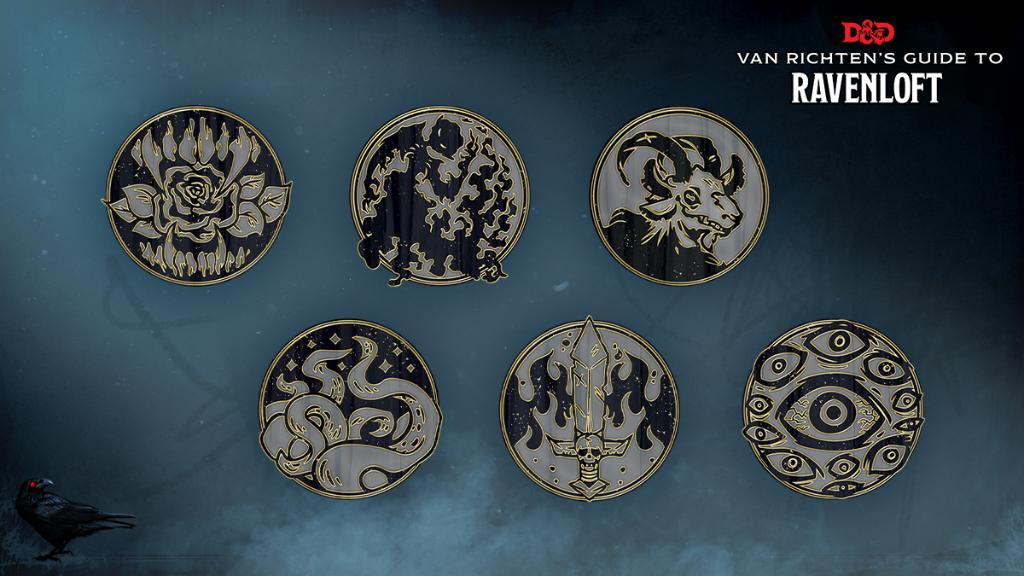
 In a recent tweet, the D&D team posted a set of icons representing six types of horror (the icons were made by Trystan Falcone, a.k.a. Walnut Dankgrass of "C"-Team fame).


The genres, as described in other tweets, are, starting with the top row from left to right, Gothic Horror, Ghost Stories, Folk Horror, Cosmic Horror, Dark Fantasy, and Body Horror.

Given the attention drawn to these six, I suspect that they'll be the focus of Van Richten's Guide to Ravenloft's exploration of the broader horror genre. Let's look at their descriptions (in tweets) of these genres and talk about some examples of stories that use these tropes and ideas of how to build them into adventures.

There haven't been tweets for all six of them, so I'll just go in the order that they've posted about them.

    Dark Fantasy: "Dark fantasy is as much a genre of fantasy as it is a genre of horror. Dark fantasy refers to fantasy worlds where grim themes, nihilistic plots, or horrifying elements inform a fantasy tale."

The image accompanying this tweet shows a headless horseman. While most Americans would associate the Headless Horseman with Washington Irving's The Legend of Sleepy Hollow, the trope goes back a long ways, tracing back at least to the Celtic myth of a monster known as a Dullahan, which looks like a decapitated man on horseback carrying his own head, but is actually a single monster.

Personally, I've always felt that Fantasy is just horror in which humanity (or a broader group of humanoid races) have the tools needed to stand up to the nightmarish monsters. The Orcs, Balrogs, and Ringwraiths of Lord of the Rings are all terrible monsters, but in that universe, the forces of good are ultimately more powerful, even if they must fight with their all to triumph over evil.

Dark fantasy, thus, lets you more or less leave the monsters as scary as they are in traditional fantasy, but reduces humanity's capability to defend itself from them - whether by simply not having access to high magic or because society is too dysfunctional to present a united front (A Song of Ice and Fire being a great example.) Dark fantasy also often has the would-be defenders of humanity be power-hungry and selfish, such as in The Witcher series.

    Folk Horror: "Folk horror explores fears of isolation, superstition, paranoia, and lost truths. Seemingly idyllic communities, rural reclusiveness, forgotten traditions, and naturalistic cults all frequently feature in folk horror adventures."

European history underwent a massive shift with the arrival of Christianity. Not to imply that previous religious structures were all harmonious and wonderful, but the extremely thorough campaign of conversion across basically all of Europe rendered many of the old religious practices and beliefs taboo. Indeed, while some religious traditions incorporated other faiths into them (such as how the Norse faith likely assimilated faith in the Vanir gods after taking over a Vanir-worshipping people, and simply made them a kind of second pantheon in addition to the Aesir) a lot of monotheistic faiths instead turned the gods of older, conquered cultures into monsters and demons. Baal, a Mesopotamian deity who was meant to be a kind of heroic patriarch, became the foundation for entities like Beelzebub in Christian tradition - the demonic Lord of the Flies.

So, to an extent, there's a fear of past beliefs and traditions that one's own ancestors might have taken part in. There is also a certain colonialist fear - that, as conquerors, we don't dominate the conquered land as much as we think we do.

But there's also an element here that's more about the divide between the urban and the rural. It's far more difficult for bad people to hide their deeds in urban environments, but the remote and rural places of the world have the advantage of obscurity. I think the most obvious Folk Horror example would be The Wicker Man, in which a person we're meant to relate to - a city-living detective - is drawn into a remote place under the control of a pagan cult with murderous fertility rituals. More recently, the movie Midsommar has a similar premise, where a group of American tourists are drawn into a similarly murderous cult that dresses up its evil in a cheery "traditionalism."

    Ghost Stories: "Ghost stories touch on the issues of human existence: the nature of the soul, the weighty fact of morality, and the burden of ancestry and history. Spirits represent supernatural justice, as well as grief and the need for closure."

Tellingly, "ghost story" can also kind of serve as a general term for any kind of scary story, aka horror. But to speak specifically to this subgenre, I think ghost story horror is often the most deeply personal. A ghost typically has some sort of unresolved business in the world, and surviving such a tale often involves uncovering the past.

There's a live show that the podcast Welcome to Night Vale had a few years ago called Ghost Stories (Welcome to Night Vale itself being a kind of intersection of cosmic, surreal, and dystopian horror undercut or sometimes enhanced by its sense of humor) that had a really touching point at the end - that in some ways, a ghost story is a hopeful one. We want our loved ones and ourselves to persist in some form after death. Personally, I found myself listening to that performance around the time my mother died of cancer, so it hit me very hard.

Ghost stories don't have to be tear-jerkingly tragic, though. In some ways, the existence of a malevolent ghost can mean a horrific escape from justice. Freddy Kreuger from the Nightmare on Elm Street series is basically a ghost, but death has made him far more unstoppable than he was as a merely mortal serial killer.

Usually, you can just kill the monster to survive in a horror story. But if the monster's already dead, that solution is harder to come by.

    Cosmic Horror: "Cosmic horror revolves around the fear of personal insignificance. The genre is predicated on the idea of entities so vast and so genuinely beyond our comprehension that we cannot fathom their simplest motivations."

It's funny, because the aesthetics of cosmic horror are not always connected to the themes. Usually, when we think of Cosmic Horror, we have images of Cthulhu, or maybe The Thing, and often weird cults that always seem to involve tentacles.

I've often felt that Demons in D&D (specifically demons as opposed to other types of fiends) have a big overlap with cosmic horror monsters, which are also represented in D&D with things like Mind Flayers, Star Spawn, and Beholders, largely because they both seem associated with madness.

But in a way, I think that the madness inflicted by demons is more of an intended effect. While Beholders and Mind Flayers are generally given a Lawful Evil alignment, I think it might be more accurate to say that they're "none of the above."

Key to this genre is ignorance - you can never completely fathom what these things want.

It's hard to talk about this genre without mentioned H. P. Lovecraft, though the very thing that makes him a problematic writer is also partially what makes the genre a little harder to grasp for modern audiences. Lovecraft's horrible-even-for-the-1920s racism informed his notions of fear of the unknown. In a lot of ways Cosmic Horror fits a bit more with science fiction than fantasy, and I think that more optimistic sci-fi, like Star Trek, served as something of a rebuttal to Lovecraft's entire premise - rather than fearing the unknown, Star Trek suggested that we might actually find advanced peoples and entities that share or even exceed our virtues and values - and that finding them could be to humanity's betterment, rather than our downfall.

Still, just as we talked about Dark Fantasy almost having a dial you could turn to determine how horrific it is, we can dial down the optimism from Star Trek-style sci-fi to encounter beings that are alien both in origin and nature, and who truly don't see any value in human(oid) life. The Mind Flayers are a good example here - where they're really only interested in us to either create more of themselves or consume our brains.

Actually, to go a bit further with the Mind Flayers, the most cosmic horror part of them is that they seem to have this profoundly ancient empire, but no one has any idea how it came to be. The Aboleths - themselves cosmic horror monsters who pre-date the arrival of the gods - have 100% perfect memory of their entire existences (and even inherit the perfect memories of their parents) and yet they don't remember the Ilithids' rise to power - suggesting that the Mind Flayers somehow aren't even from the past, which implies that they might be from the future instead. (And what does that mean? Are these horrifying tentacle-face monsters the future of the humanoid races? Or something that will wipe them out?)

    The two subgenres they haven't made an official tweet for are Body Horror and, oddly enough, Gothic Horror.

I've talked a bit about Gothic Horror before, but let's touch on these both briefly.

(EDIT: They've made their Gothic Horror tweet: "Gothic horror is about the terror within, not without. It shatters the illusion of humanity in a poignant way by holding a mirror up to us and saying: look at what we truly are, and look at what we pretend to be."

I think this description is interesting, in that it plays into more of the Poe-style evil within humanity, such as when you consider the narrators of The Telltale Heart and A Casque of Amontillado. Gothic monsters are dark reflections of humanity, but a monster need not inhuman in any physical way - it's the ravenous, murderous beast lurking in humans themselves.)

    Gothic Horror, I think, is deeply tied to the Romantic Movement (Mary Shelley wrote Frankenstein as part of a "ghost story" contest with her husband Percy and Lord Byron, among others). To put it very simply, the Romantic movement was reaction to what was seen as the overly-cerebral Age of Enlightenment, trying to bring emotion and individualism into its narratives after a period in which even fantastical fiction was written in a meticulous style that mimicked the detachment of scientific literature (if you want a fantastic exploration of these styles, read Jonathan Strange and Mr. Norrel, which is a fantastic novel - just be warned that the first part of the book is meant to mimic that pre-romantic style because it focuses on Mr. Norrel, whose personality is profoundly pre-romantic.)

As I wrote in my earlier post, one of the major themes of Gothic Horror is the idea of humanity transformed. Whereas cosmic horror is about the totally alien, and dark fantasy often involves evil gods and demons and such, the monsters of gothic horror tend to be former people who have become monsters - the werewolf, the vampire. Mr. Hyde is what happens when all the good is removed from Dr. Jekyll. Frankenstein (Adam, rather than Victor) is, ironically, the reverse - someone who should have been allowed to become human, but whose humanity was denied to him.

But in any case, the monster is something like a human, but with certain inhibitions against evil acts removed (again, I think it's worth noting that Frankenstein's monster behaves more like a conscious human being who is simply consumed with a desire for vengeance against his creator, rather than being a totally soulless monster - he's also probably the most eloquent character in the novel, quite different from the Boris Karloff version.)

I think one of the potentially interesting things you can do with gothic horror is to suggest that there's something redeemable in the villain, even when there isn't - sort of crocodile tears. There's a moment in Curse of Strahd (Strahd being a 100% gothic horror villain) in which, after we burned the giant effigy of him that a group of evil druids were worshipping, he didn't retaliate, and just seemed kind of sad. It was a moment where, despite myself (and partially in keeping with my lawful good paladin's personality,) I wondered if there might be some way to reach the humanity inside him.

But the horror, then, is that that humanity isn't really there anymore.

Moving on:

Body Horror is sort of a weird concept for a subgenre itself. I'd argue it's more of an element within the horror genre that several subgenres make use of. Perhaps the most common example is the werewolf - often, werewolf stories focus on a protagonist who has become a werewolf, and has lost control of the human impulses not to harm other people, even if they are horrified by their acts.

But the transformation from human to wolf-like being can, itself, be horrific. The movie An American Werewolf in London is famous for its horrifying transformations scenes.

I guess if we're going to define body horror, it's the horror of one's own body being violated in some way - some unexpected transformation. Often, this transformation can be painful, but it's not even just the pain that's horrific - it's the notion that your own very physical form is becoming something unrecognizable.

David Cronenberg, the director, is probably the filmmaker most famous for his use of Body Horror. His remake of The Fly, starring Jeff Goldblum and Geena Davis, presents the ongoing decay of Jeff Goldblum's Seth Brundle from 1980s-Jeff-Goldblum-handsome to horrifying fly-person, watching his human body fall apart piece by piece.

John Carpenter's The Thing blends cosmic horror with body horror - the monster in that is a multicellular alien colony that can infect people, and hides in plain sight, but when it is revealed, the body of those infected transforms into horrifying, shapeless monstrosities. While fear of the other characters potentially being The Thing is certainly part of the paranoid terror of that story, there's also the fear that, if a person doesn't know they've been converted until it's revealed, even you might find yourself suddenly transforming in these horrific ways.

Hell, let's look at another sci-fi, cosmic horror example: Alien. While the Xenomorph is mostly an external, predatory monster, the method by which it is brought aboard the Nostromo is pure body horror - John Hurt's Kane believes he's been lucky enough to survive an encounter with an alien, only for the newly formed young xenomorph to erupt from his chest, killing him. And let's not forget that the design of the Xenomorph was very deliberately made to evoke human sexual organs - after all, what's more horrifying than the parts of the body that we, you know, use when we're doing some very important social bonding/propagating the species turning out to be deadly threats? Like a lot of horror that makes the familiar and safe into the mortally dangerous, Body Horror takes it a step further to something that's beyond familiar, but is in fact a literal part of ourselves being the danger.

(Content Warning: I'm going to describe an injury I sustained as a child in the next paragraph.)

I think Body Horror is a very special kind of horror because the integrity of our own bodies is fundamental to our sense of health and safety. When I was six years old, I got in an accident in which I thrust my hands through a window, and the shards that fell sliced up my wrists (I feel very lucky that I still have total control over my hands, and that no major nerves were severed - I got a hundred stitches, to give you an idea of how nasty the cuts were). Looking at my own left wrist and seeing into the deep gouge the glass had cut, with exposed fat and blood, and I think maybe some muscle and blood vessels is one of the most shocking things I've ever witnessed. Today, 28 years later, my wrists both have large scars, and the left one is basically a big mass of scar tissue connecting various flaps of skin, even if time has smoothed it over significantly. 

(Moving On.)

Body horror is kind of the fear of betrayal by the very thing you are - not even a trusted loved one, but your literal own physical form.

Anyway, I'm eager to see how the book will handle the use of these various genres. It seems Van Richten's Guide to Ravenloft has a massive amount of content to cover, between the gothic lineages, two new subclasses, what I hope to be an extensive bestiary, and descriptions of many different domains of dread.

I'm also eager to use these subgenres as kind of modular pieces to build domains of dread. I already have a vague concept for a domain built around the idea of doppelgangers, but I want to hold off on working too much on it until I've got the book.

Saturday, April 24, 2021

Ravenloft, Maybe Dragonlance, and What Next?

 In a little under a month, Van Richten's Guide to Ravenloft will release, giving us an official 5th Edition campaign setting sourcebook for the Ravenloft setting. I vaguely recall folks at WotC saying that this year would see the release of three different classic D&D settings for 5th Edition, so I'm naturally speculating about them.

Ravenloft is actually one of the most unusual settings, with a pretty distinctive feel and arguably a different genre than general D&D. With its horror focus, along with its unusual supernatural setting, it's an exciting addition. Ravenloft is also the setting of what I think is generally the most popular adventure book in 5th Edition, Curse of Strahd.

D&D's relationship with the Forgotten Realms is kind of odd - while the world of Toril is just one of many in the Prime Material Plane, the game tends to focus on it, and specifically the continent of Faerun (and within that, the Sword Coast) as the central setting for D&D. I don't totally know the history of planes as they were developed for D&D, but people often refer to even such far-flung places as The Abyss as technically part of the Forgotten Realms setting, even though most settings do link to these same Outer Planes.

I actually don't know if it would make sense to get a Forgotten Realms sourcebook, then. Many of the adventure books have focused on notable areas of the Forgotten Realms, and books like Waterdeep Dragon Heist, Baldur's Gate: Descent into Avernus, and Candlekeep Mysteries have all spent a little time outlining the locations themselves - between those and Sword Coast Adventurer's Guide, there's already a ton of information for the Forgotten Realms anyway.

Months ago, when we got the Gothic Subclasses and then the Gothic Lineages in Unearthed Arcana, I became fairly confident that we'd be getting a Ravenloft book, and wouldn't you know it: that's what's happening.

More recently (maybe overlapping?) we've gotten a set of Draconic subclasses as well as the recent UA involving variants on existing draconic races along with feats and spells tied to dragons.

I know very little about the Dragonlance setting, other than it's a world called Krynn, and there are these things called dragonlances that are really good at killing dragons. But I'm given to understand that some of the spells in that recent UA referred to specific people (or dragons) from Dragonlance, and that makes me feel fairly confident that a Dragonlance book could be the next one we're getting.

It also makes a fair amount of sense in terms of tone: Ravenloft is such an unusual, metaphysically strange setting that it would make sense to do a full 180 from that and give us a really classic fantasy setting.

So if two of three are Ravenloft and Dragonlance, what would the last one be?

Personally, between the Forgotten Realms, potentially Dragonlance, and the recently-canonized Exandria (man, it must be cool for Matt Mercer to see his homebrew setting become official) I think we're reasonably covered on traditional fantasy settings.

One option to expand into would be for more idiosyncratic settings. I love Eberron's pseudo-modern (or at least pseudo-20th-century) feel, though I think I'm unlikely to run a campaign set there given that my own homebrew setting has a fair number of overlapping ideas. The MTG crossover setting books are very high-concept - Ravnica's city-world and Theros' mythological approach to time and distance.

Personally, the setting I'd be most excited for is Planescape.

Now, Planescape books tend to focus a fair amount on the city of Sigil, which actually bears a resemblance to Ravnica (it's older, for those keeping score.) Sigil, like Ravnica, is a massive city, and it's also the home of several factions with radically different philosophies that all jockey for power.

But Planescape is not just Sigil - not only does it include the vast True Neutral plane of the Outlands, but technically it encompasses, well, all the planes. The Outer Planes, the Inner Planes, the Prime Material, etc. You could argue that every D&D game is a Planescape game, but that most of them just focus on one tiny corner of the setting.

Technically, you could argue the Baldur's Gate: Descent into Avernus was a bit of Planescape mixed with Forgotten Realms. But I think what I find really cool about Planescape is the way that the Outer Planes seem to operate independently of what's going on in the Prime Material Plane. And it's pretty much all surreal landscapes that are literally otherworldly.

Among other things, I think Planescape is a setting in which you could probably more easily build high-level adventures. While there shouldn't be anything preventing people from rolling up at level 1 (I sort of want to start players off at 1 in the Abyss, or have their first adventure be an escape from Carceri) I feel like the massive scope of Planescape would encourage people to play at high level, which is something that you don't tend to see much.

But let's examine some other options.

Greyhawk is another natural possibility. It's actually the first official setting for D&D, created by none other than Gary Gygax himself. Greyhawk (a world called Oerth, which I always assumed was pronounced just like "Earth," though supposedly it was intended to be like if you had a thick, old-timey Brooklyn accent, so more "oyth") is another prime material world, and is still based in a sort of High Medieval era like most fantasy. The main difference for Greyhawk is its tone - while Forgotten Realms tends to assume players will be heroes who want to fight back against the forces of evil that threaten the world, Greyhawk is a dark and gritty world where player characters are more expected to be in it for riches and glory. Your motivation to enter some deep dark dungeon in Greyhawk is primarily to get the treasure hidden within, not because there's some major threat to the world above.

Gygax, of course, was inspired by pre-Tolkien fantasy stories like Conan the Barbarian, where we weren't really rooting for the heroes because they were heroic, but more because they were just kind of badass and awesome.

To be honest, I think that this tone actually makes the alignment system make more sense - in a classically heroic game, it's really hard to fit evil-aligned characters into a party. But if the party is an alliance of convenience among a group of sell-swords and treasure-hunters, there's a bit more room for evil characters and good ones to cooperate. The good-aligned paladin might think that the evil rogue is a blight on the world, but the paladin's got to get that sacred relic for their quest, and will accept the help for now.

5th Edition has visited Greyhawk in the anthology Ghosts of Saltmarsh, though Saltmarsh itself (a Greyhawk location) doesn't necessarily play a role in any of the individual adventures.

Now, let's talk Spelljammer.

Spelljammer is a perennial request from D&D fans, but it's also arguably the weirdest thing that D&D has ever come out with. A pseudo-science-fantasy setting, Spelljammer does take place on the Material Plane, but it imagines each of the existing D&D settings to function as planets within their own "crystal spheres." Crystal spheres are a medieval theory about the nature of the cosmos, explaining the stars and planets as bodies moving within concentric spheres. In Spelljammer, each of these spheres bound one of the game's material plane settings along with other locations (such as moons and other planets,) but using a spelljammer-type ship, you can visit other spheres and their worlds.

While it keeps things rooted in medievalism and not any kind of modern conception of physics, the general vibe of spelljammer is a bit more of that kind of science-fantasy space opera. Furthermore, it's the most explicitly comedic setting, with a lot of really out-there and silly concepts (such as the fact that gnomish space ships all use Giant Space Hamsters running on wheels as their primary power source.)

Spelljammer was not a success back in the late 80s and early 90s, when it was introduced. It's a decidedly out-there concept. But I think that with the far broader popularity of science fiction and fantasy, audiences might be more willing to take the weird journey that is Spelljammer.

Personally, I've always loved mixing the chocolate of sci-fi with the peanut butter of fantasy, and so I'd be really happy for Spelljammer to be a thing. But we'll see if they have any really strong concepts to introduce with it.

One of the settings I remember hearing a lot about back in the day was Dark Sun. Dark Sun is a sort of post-apocalyptic setting in a desert world. There a few defining elements: one is the rarity of metal, forcing most people to get along with weapons made of materials like bone. An other is that arcane magic seems to be destroying the world, and the powerful hoard that kind of magic, ruling with an iron fist. The third is that psionics are a big part of the setting, which is something 5th Edition has only started to explore (there are three subclasses in Tasha's that are built around it.)

There are other D&D settings, of course, but just as my own neophyte self, I don't know that I really have much of a sense of, say, Birthright or Mystara.

Personally, I'm not really that interested in the more mundane settings (mundane being, of course, relative given that we're talking about fantasy worlds.) I'm all in for the surreal weirdness of Planescape or Spelljammer.

I will say, though, that if we're looking at Unearthed Arcana as hints for what might be coming (which is what I'm basing my guess that Dragonlance is coming next) I think we should pay attention to the "Folk of the Feywild" playable race options. The Feywild has generally not been treated as a campaign setting in and of itself, at least in 5th Edition, but I wonder if we could get some sort of sourcebook for a part of the Feywild, much as the Demiplane of Dread from Ravenloft is technically a part of the Shadowfell. (4th Edition, which introduced the Shadowfell, did have a full campaign setting book for it, though my sense is that WotC is really more interested in Ravenloft as a setting than the broader Shadowfell.)

We're apparently getting a fair number of 5E books this year, with Candlekeep Mysteries already out and Van Richten's coming soon. I wonder when we'll hear about what comes next.

Wednesday, April 21, 2021

D&D Classes - Who Does Best When Dumped Naked into the Nine Hells?

 In my usual Sunday game, our DM had us travel through a portal to the Nine Hells in a post-Descent into Avernus Elturel (I think the AL-league game I played with the same DM is canon in her version of the Forgotten Realms, so it's the good ending). But we got dumped out into Avernus (I assume we're on that layer) with literally all our stuff, including clothes, left behind in some kind of magical net rigth above the portal.

We then got attacked by six Merrengons, a type of devil with a creepy child mask for a head and heavy armor with halberds and heavy crossbows.

The party consists of:

Myself, an Eldritch Knight Fighter

A Devotion Paladin

An Open-Hand Monk

A Forge Cleric

A Gunslinger Fighter/Horizon Walker Ranger

and an Undying Warlock/Wizard (I think she only has one level, so has not chosen a subclass yet.)

The combat is still actually going (though we've got 4/6 of them down.) So far, the paladin was able to find a shard of bone to use as an improvised weapon while I took a halberd off of one of the fallen devils - which is sadly non-magical, but at least gives me the material component for Booming Blade, so I can start putting some magical hurt on the monsters. Our gunslinger got a crossbow, and eventually some bolts, so we're getting back up to speed.

Anyway, being completely bereft of all gear, it really started to hammer home that some classes do a lot better in that situation than others. Let's go down the list!

Artificer:

The Artificer is probably the most screwed in this situation. While I don't know that all DMs would enforce this, technically an Artificer needs a spell focus (their tools, or other subclass-based foci) to cast any spell - not just those that have material components. A Battle-Smith at least, if they could find a weapon, could still use their extra attack, as could an Armorer, but in both cases, they likely won't be able to use their Intelligence to attack as normal.

Barbarian:

The Barbarian is fairly well-suited to a situation like this, given that they have unarmored defense to get a decent AC (my poor Fighter went from 22 to 10). The Barbarian will need to find a weapon, but is otherwise at full capacity.

Cleric:

Like most casters, your spell choice will be limited based on what has a material component, but there are plenty of options that only have verbal and somatic components. Clerics are one of the better-armored casters, so this will be a bit of a downside.

Druid:

Like the Cleric, you'll need to choose spells wisely. That being said, a shape-shifting-focused Druid will do just fine.

Fighter:

Fighters, I can say from personal experience, are going to be in for a hard time. Losing your weapons and your armor is pretty nasty. I'd say a Dex-based fighter will at least be in slightly better shape thanks to their higher inherent AC, though they'll also be in worse shape if they have to rely on unarmed strikes. As an EK, I pre-cast Mirror Image before we rolled initiative, and it saved me from three crossbow bolts in a row.

Monk:

Monks are basically the opposite of Artificers here. While a Monk can still benefit from equipment like a +1 Quarterstaff or Bracers of Defense (or a Cloak of Displacement, in our monk's case) a Monk really, truly doesn't need any equipment to be fully effective. Indeed, at level 12, his unarmed strikes do as much as a quarterstaff wielded with both hands anyway, and unarmored defense provides the bulk of any Monk's AC, so they're kind of just good to go.

Paladin:

Paladins, like Strength-based fighters, are going to run into the issue of low AC, and they need a weapon. However, any weapon will do for Divine Smites, so they can actually put out some respectable damage (especially given that, at level 11 and higher, every attack does an extra 1d8 radiant damage, even if the improvised weapon was doing a mere 1d4.)

Ranger:

Another martial class, Rangers are going to really miss their weapons, though different subclasses might fare better.

Sorcerer:

Sorcerers are probably one of the best-off classes. While some spells will still require components, a Sorcerer likely has access to many spells that don't, and they're used to being unarmored.

Warlock:

Warlocks already rely significantly on Eldritch Blast, which has no material cost, and a Bladelock will be able to summon their weapon to them across planar boundaries (unlike my Fighter's weapon bond, which requires the weapon be on the same plane of existence). Warlocks do like to wear armor, though most will only have light armor, which wasn't adding much.

Wizard:

Wizards on one hand have a lot of the benefits of a Sorcerer, but without their spellbook, they can't actually swap out any of the spells they have prepared. If an Order of Scribes Wizard finds a blank book, they can transfer their book's contents to the new one, though.

Tuesday, April 20, 2021

Will We Lose in 9.1?

 Shadowlands is the highest-stakes expansion WoW has ever had, which is impressive given that just two expansions ago we put an end to, or at least scattered, the Burning Legion. With every newly-dead person being sent to the torment of the Maw it's clear that we not only need to fix this issue but also figure out some way to get them all out - not to mention that we need to stop the people doing this.

In 9.1, we'll be exploring a new region that has been dragged into the Maw, along with a raid at the top of Torghast, where we'll confront Sylvanas and, one hopes, free Anduin from his dominated state where he has been forced, essentially, to become what it looks like the Jailer meant Arthas to be (while we're at it, can we find Arthas' soul?)

But there are a couple things to note here:

Despite this looking like the "big Maw raid," it's coming in only the 9.1 patch. While I don't know what the patch schedule is going to look like for Shadowlands, especially in this weird Covid time (I'm hoping we still get three major patches as usual, even if the last of them winds up coming a decent chunk into 2022,) it's notable that we're not going to be fighting the Jailer himself in this raid.

On top of this, Blizzard has come out and said that the end of this raid will have huge implications for the future of the WoW cosmos.

Which all comes around to make me think: Are we going to lose?

The Jailer's ultimate plans are not 100% clear, though it does seem that he wants to make Death, among the six Primal Forces, the triumphant one. While Death has generally been seen as an evil in its manifestations in Warcraft's past, we now know that the Scourge and necromancers are actually more representative of the Jailer specifically (borrowing some techniques and strategies from other Shadowlands regions) while there's plenty that's benevolent within the realm of Death. In order to do what he needs to do, though, the Jailer needs to reach the Arbiter at the top of Oribos and... kill her? Absorb her power? Something like that?

So, I had previously thought we might have a final raid in which we have to fight through and defeat the Jailer's assault on Oribos, fighting him up there and trying to prevent him from killing the Arbiter - maybe with the final fight ending as the Arbiter re-awakens and destroys the Jailer or something.

But... maybe I'm wrong?

There has been some datamined stuff that suggests our fight with Sylvanas is more far-reaching than just the top of Torghast.

There's a TV Tropes page for "You Can't Thwart Phase One," which makes a lot of sense for building a narrative. Essentially, in the early part or middle of a story, the villain has to be making progress toward their goal. The hero might score some early victory, maybe taking out a henchman, but usually the henchman or obstacle that the hero overcomes is a distraction from the larger issue. Indeed, the "victory" can often just be more about survival than triumph. But even if the hero makes a proactive strike against the villain, you can't have the villain's plan fail then and there, because then the story's over.

It's not always the case, of course. You can have a story in which the hero's early victories force the villains to change their plans. Legion, for example, has us first thwart Gul'dan from turning Illidan into a vessel for Sargeras, and then has us prevent Kil'jaeden from escaping to regroup, which forces Sargeras himself to attack Azeroth.

Still, I think that there's a good chance that this is where we're going with Shadowlands. What, then, happens if he does reach the Arbiter?

Well, the Shadowlands themselves are probably in for a lot of trouble. But there has been subtle hinting that the way that the Shadowlands are set up in the first place is kind of flawed. Maybe something better could be built from the wreckage?

The big question, though, is that if the Jailer succeeds, what does it mean for the rest of Shadowlands?

There has been some talk about some future "cosmic disco war" in which all the primal forces in the Warcraft Cosmos come into conflict. That feels like it could be its own expansion, or even several expansions. If that's the case, could Shadowlands be the first within that set? I'm inclined not to think that's how they're playing it, as I think Blizzard will generally try to change tone and scope with each expansion to keep us from getting bored - meaning I think that the next expansion is probably going to be something much more grounded and set on Azeroth (Dragon Isles, maybe?)

Still, the scope of this expansion, which is already massive, could get even bigger if the Jailer sits triumphant at the end of the 9.1 patch. Assuming we get the usual three major content patches, we'd have two more raids to go through. I think it's likely that we'll be taking the Jailer down by the end of this expansion (I think Blizzard explicitly said that they wanted to do an expansion where you knew who the final boss would be at the beginning when talking about Shadowlands). But if Sylvanas is handled in 9.1, I have genuinely no idea who the final boss of the middle raid will be (especially with Kel'thuzad also being handled in 9.1.)

I've been on a bit of a WoW break the past couple weeks - I think I got a little burned out, despite the fact that 9.0 is one of the best opening patches an expansion has had - I don't want to burn through my enthusiasm for the expansion entirely before 9.1 comes out.

It's a real shame that there's been such a delay, but then, this past year (and change) has been a once-in-a-century thing (at least I hope we don't get another pandemic like this for a hundred years - we'll see what climate change has to say about that) and I can't really blame anyone for running into difficulties keeping up with their usual schedule. I got my second vaccine shot a week ago, and so we seem to be approaching a light at the end of the tunnel, but of course, delays of content releases could also mean delays of future content releases. Frankly, I wouldn't be shocked if we just see the whole "roughly in fall in even-numbered years" release schedule for WoW expansions get shunted back a bit because of this.

Mapmaker, Mapmaker, Make Me a Map

 Some time last year (what is time?) a friend of mine introduced me to Inkarnate, which is an online map-making tool, useful especially for tabletop RPGs like D&D. Initially, I was primarily interested in using it to make big maps of my homebrew world: drawing the continents and nations, locating cities, etc. It actually helped me a lot in fleshing out my world: once I'd gotten, for example, the Republic of Nephimala worked out (a country that's based on America in the late 19th and early 20th Centuries - essentially high fantasy meets wild west) I realized how much more there was to flesh out - once the major cities were there, I added other towns and then geographical features like rivers, mountains, forests, and deserts. Among the towns that I added was an important crossroads where the rail lines and roadways converge, called Prospect Junction, which might be the most Old-West-y sounding town name I've ever come up with.


But I was intimidated by the amount of detail that might be required to make battle maps, so I've hesitated until recently.

However, after playing around with it while planning a one-shot when many of my players couldn't make my regular game, I realized it wasn't too hard to build something. And now I've kind of become obsessed - using it to build not just battle maps, but detailed dungeons. The players in my Ravnica game are eventually going to go on what is essentially an Underdark adventure (through Ravnica's Undercity) to get to the Golgari member of the guilds-spanning Phyrexian conspiracy, and I've created a few layers of dungeon-like environments for them to explore (it's possible I've overdone it - there's a boss monster at the end of each layer).


Anyway, I just sort of wanted to sing the praises of this website. There's a bit of a learning curve, but you'll start to make some really amazing maps as you start to figure out the nuances of the system.

In fact, I can give a brief tutorial on the basic systems, which I'll put behind a cut. Anyway, enjoy the maps I've posted.