Tuesday, February 28, 2023

The Lord of Frenzied Flame

 Well, in the interest of completion (I almost spelled that "compleation" as I've been running a D&D game set in Ravnica with the Phyrexians as the big bads) I beat Elden Ring (for the 5th time,) finally picking the Lord of Frenzied Flame ending (I've done Age of Stars three times and Age of Order once - I'd intended my previous character to go Duskborn but then the transfer from my PS4 to my PS5 lost my trophies, so I wanted to have Age of Stars first).

Anyway, I'm feeling a little bummed because I generally err on the side of "good" endings (admittedly what constitutes a "good" ending in FromSoft games is always up to interpretation. Personally I think the most likely ones to count as good are Order and Duskborn) but this is almost certainly the worst. Like, the Age of Curses or whatever the Dung Eater one is surely seems pretty bad, but I'm not convinced that the Seedbed Curse is actually necessarily evil so much as the return of kind of wild, primeval magic of the Crucible.

But the Frenzied Flame has got to be bad, right? Given Melina survives (also: I think at this point we can be pretty certain she is the Gloam-Eyed Queen, right?) I think it's really just the Erdtree and Leyndell that are melted into Frenzied slag (the presence of large burning fingerprints on the walls is perhaps a worrying sign that the Three Fingers are still around) though the world is surely going to have a lot more frenzied folk going around.

One thing that is very open to interpretation is just what the Frenzied Flame is and where it came from. There's a possibility it's one of the Outer Gods like the Formless Mother or the unnamed Rot God. Some put the Greater Will in that category. Personally, I believe that the Flame is something like a corruption or perversion of some other principle - possibly the Greater Will. If you think about it, the Golden Order holds the Law of Regression as one of its key premises. The Frenzied Flame promises to burn and melt everything down back into a single whole.

I think it's implied that the Three Fingers and the Two Fingers were probably once part of a unified entity (there was even another ending, I believe, that never made it live, which would have seen the two united in the Age Absolute). I also think it's notable that melting things together is exactly what one does in a crucible, and thus the Crucible, which was a previous form of the Erdtree, might have represented a healthier version of this reunification (in that case, we have things like the so-called Misbegotten who were originally viewed as blessed because they mixed human and animal traits).

Something's deeply wrong with the Frenzied Flame, though, and it seems to be one of the more Cosmic Horror-like things in the game. There's another questline that never made it into the game involving the Wandering Merchants, where it looks like they were accused of being Frenzied Flame worshippers and were the victims of a pogrom, leading some of them to then turn to the Flame out of a despairing desire for vengeance. (If you've gotten the Frenzied Flame ending or just been to the Frenzied Flame Proscription, you've seen the massive number of bodies of these people sealed up beneath the capital.

Indeed, the Flame is kind of seductive. Vyke, whom we fight once as an invader in Liurnia (and need to fight to do Hyetta's quest) and later in an Evergaol, looks like he was basically going on the same journey as we were, and got farther than any other tarnished, but when he realized he'd need to burn his Finger Maiden to reach Marika, pursued the Frenzied Flame as an alternative. Indeed, we can do the very same to avoid killing Melina, though she begs us not to risk it. The difference, though, is that if we also do Milicent's quest line and purify the Unalloyed Gold Needle after defeating Malenia, and then doing some crazy time shenanigans by traveling to the distant... um, past? Or Future? where Placidusax is, we can cleanse the Flame and thus both spare Melina and avoid allowing the Frenzied Flame to consume the world. (Once again, the fact that Miquella seems to have found a way to save people from Outer God influence - presumably intending first to save his sister from the Scarlet Rot, but happily also saving us from the Frenzied Flame - reinforces my impression that he might be the most good-aligned character in the lore - though watch the DLC show that he's actually some horrifying monster).

One of the creepiest things about the Frenzied Flame is its association with body-snatching. We meet Yura early on in Limgrave, a badass samurai who hunts Bloody Fingers (basically, people who go around murdering other Tarnished). However, when he dies, we see his body again possessed by a figure named Shabriri (a figure/curse from Jewish folklore associated with blindness). Shabriri is referred to as a demon, and seems to very much be one (fun fact, you can summon him to fight Godfrey at the end of the game, and he'll fight alongside Nepheli Loux, who must not know who he is - oddly you can even do this after you get Yura's old gear, though he still seems to be wearing it). Hyetta's an odder situation, though. Like Shabriri, she seems to be possessing a corpse - in this case, Irina, who asks you to take a letter to her father, Edgar, in Castle Morne. Upon beating that "medium dungeon," Edgar finds his daughter killed by Misbegotten, but you then see Hyetta in Liurnia shortly after beating Godrick the Grafted.

Unlike Shabriri, however, who seems to fully understand the Frenzied Flame and all the chaos it would entail, Hyetta seems to be an innocent. Frenzied Flame cultists come and bring her "Shabriri Grapes" to eat, and after you give her a few, and tell her what they are (Frenzied Flame-melted eyeballs, for the record) she is horrified and throws up - though she gets over this because of the effect it has on her kind of inner-vision.

Ultimately, Hyetta winds up fully committed to the Frenzied Flame, and basically becomes the Finger Reader for the Three Fingers, giving you their message and the Frenzied Flame Seal as the Frenzied Flame melts her own eyes and then, it appears, her entire body.

So, is Hyetta a demon like Shabriri? It seems odd if that's the case that she wouldn't be fully on board from the get-go.

Anyway, even if we purge the Frenzied Flame from ourselves, Melina doesn't come and congratulate us. At the very least, we can feel confident that she survives if we don't burn her at the Forge of the Giants.

That said: are we sure she dies if we do?

Melina is insistent that you don't pursue this path. She is committed to her role as "kindling maiden" to burn the Erdtree. And there are several hints, in fact, that she's a secret daughter of Marika, not the least of which is that of the three Butterfly crafting items we find, we see plenty of Smoldering Butterflies along with the Nascent and Aonian ones. The latter two can easily be affiliated with Miquella and Malenia, respectively, and Melina's appearance and name are both consistent with the possibility that she is another child of Marika and Radagon (which is to say, of Marika). Early on when we meet her, she talks about being burned and bodiless - and indeed, she already has burn marks on her hands.

Is it possible that this isn't the first time she's burned the Erdtree?

If we take into account the story of the Wandering Merchants, which is, yes, technically not canon as it got cut from the game, we get an example where a state of ironic cruelty led to people embracing the Frenzied Flame. Likewise, if we look at Vyke's story, it appears he took on the flame in the hopes of saving his Maiden, but we can find her dead body in Liurnia, possibly killed by a Bloody Finger.

Maybe the Frenzied Flame's whole deal is promising a way to save someone we love or avenge ourselves, but only when the damage is already done?

If you get the Frenzied Flame ending, and you get the flame before you burn Melina at the Forge of the Giants (luckily, you can't purge yourself of the flame before you get to Farum Azula, so you'll never be in a state where there's no way to light the Forge) Melina will seem to vow to kill you, revealing herself (I'm about 99% certain) to be the Gloam-Eyed Queen, who, you know, was the original holder of Destined Death.

So whatever good intention you might have for taking on the flame, Melina's not going to be happy you did. Sure, that could be just because she was willing to sacrifice herself to save the world, but it'd be all the richer if she was willing to do it because it was actually no price at all.

Anyway, I don't know if we're likely to get more about the Frenzied Flame in the DLC or even future games (of all the Souls-like games, this one is the one I can most imagine them doing direct sequels to like Dark Souls). 

Miquella and the Fate of the Empyreans

 Miquella is one of the most enigmatic and fascinating figures in Elden Ring. While there's no confirmation that Miquella will be a central figure in Shadow of the Erdtree - we don't know that it's him on the horse in the one image we've gotten - I wanted to examine this character and then look more broadly at the possibilities for the story of Elden Ring.

First off, FromSoft judiciously obscures the morality of different characters in their games. The wisdom and morality of the endings of, say, Dark Souls, is very open to debate. So any moral judgments I make are A: my opinion alone and B: not very strongly held opinions. What appears good and right might, by a certain interpretation, actually be insidious and horrible. Similarly, what might appear vile and evil could actually not be so bad (I personally think that, while The Dung Eater is 100% a chaotic evil serial killer monster, the "seedbed curse" might actually be more of a neutral change to the world, more akin to allowing wild nature magic to take root, so to speak).

So, let's talk Miquella.

Miquella is probably the youngest of the demigods, and is one of the Empyreans. We don't know if we have the total number of either category - each of the Wandering Mausoleums is said to house the body of a dead demigod, none of whose name we know. We know of three Empyreans: Ranni, Malenia, and Miquella.

Ranni is the daughter of Renalla and Radagon, while both Malenia and Miquella are the children of Radagon and Marika. There's a whole other rabbit hole to go down on whether Radagon was already the male aspect of Marika when he sired Ranni, Rykard, and Radahn with Renalla, or even whether he was anything other than Marika's other half (personally I think Radagon was originally his own person, given his anxieties about his fire giant ancestry in contrast with Marika's being a Numen and thus probably not related to anything from the Lands Between other than the folks in the Eternal Cities and the Black Knife Assassins - but let's set that debate aside for now).

If we pursue the Age of Stars ending, Ranni replaces Marika as the one Goddess of the Lands Between, though she departs to travel the cosmos for a thousand years, leaving the Lands Between to kind of do its own thing without divine influence.

Malenia is also an Empyrean, and thus the only one we fight in-game (fittingly, she's the hardest boss in the game - though I think the two-stage fight of Radagon and the Elden Beast is not exactly a slouch - on my last playthrough I did manage to one-shot Malenia pretty easily using the Fallen Star Beast Jaw, though). However, interestingly, there's never really any sense that she wants to be a God. She dedicates herself to defending Miquella (I think they're twins, but because of Miquella's curse, he winds up being a sort of younger brother). Malenia is cursed with the Scarlet Rot, and does not seem super happy about it (she's only willing to unleash her true power when desperate - though I think it's interesting that she is referred to as "Goddess of Rot" when we get her to phase 2 of her fight, implying perhaps that, briefly, there are two true gods in the Lands Between). Malenia's choice to set aside her own ambitions might just speak to her character and sisterly love, but it could be something else.

Let's now come to Miquella.

Miquella appears to be the most morally good character in all of Elden Ring. Consider the apparent purpose of the Haligtree - he makes it as a refuge for all the forsaken and exiled peoples of the Lands Between. The Misbegotten and the Albinaurics are welcome there (though it doesn't look like any of the Albinaurics make it there, unless Loretta is one.) Indeed, he and his feminine alter-ego (which, one wonders, might be similar to the Marika/Radagon situation) are associated with sleep, a non-violent way of subduing one's foes. It also appears that Miquella likely organized the Knights of the Eclipse in an effort to resurrect Godwyn's soul.

It thus seems like Miquella would actually be a very good option as the replacement for Marika should a new God arise. Perhaps under Miquella, the world would be kinder and gentler.

Miquella seems to have an ability to gain the loyalty of myriad people - he's basically universally adored. Now, you could interpret this in a sinister way, where he's able to manipulate people into worshipping him. But you could also read him as a truly messianic figure who might usher in an age of peace and harmony. Is Malenia dedicated to him because he's radiating a charm aura, or is it because she believes in her brother's vision?

Indeed, there's a part of me that wonders if our journey to the Haligtree is actually an evil act. Maybe these people deserve to have their refuge away from the rest of the Lands Between. On the other hand, with Miquella missing, it's sort of fallen to ruin. I don't know if Miquella's all-welcoming attitude actually doomed the Haligtree - allowing his sister to be there has probably caused the Scarlet Rot to spread through it, and might be the reason the tree has died. Alternatively, he might have been undone by the very appeal of his kind nature.

Mohg clearly had Miquella abducted from the Haligtree. Mohg, being a demigod Omen, has known nothing but scorn and hatred (again, I think being an Omen just means you're connected to the primal nature magic that existed before Radagon's Golden Order, so it's not actually an inherently bad thing) and must have looked upon the universal love that Miquella received and, knowing Miquella was an Empyrean, took him to be his new god, with Mohg as the Elden Lord (interesting that he talks about a new dynasty despite the fact that Mohg's father was Elden Lord). But the power that Mohg is dedicated to is corrupt and evil, and it seems that he is perhaps not really using Miquella's will or vision but simply his Empyrean blood.

We defeat Mohg (probably for the best) and, assuming it's Miquella's long arm in that cocoon (which seems likely) it looks like he's dead, though Gideon Ofnir suggests that he might actually still just be dormant.

Miquella's removal from the Haligtree might have been what ruined it - if there was any hope in counterbalancing Malenia's rot with some other power, Miquella's absence let it seep into the tree and kill it, dooming this refuge.

What I find interesting, then, is that Miquella could have been a prime candidate to replace Marika as God of the Lands Between. This, then throws our cooperation with Ranni in the Age of Stars ending into a bit of moral doubt. Ranni very well might have orchestrated the Night of Black Knives, and escaped the influence of the Two Fingers in this way. But it's also sort of implied Marika might have helped her.

The motivations of these various characters is all very questionable, but I've wondered often whether the Age of Stars is the "good" ending, or if it's one of the worst (I still think the Frenzied Flame ending has to be the ultimate "evil" ending - though I think there's a whole post to be written about how the precepts of the Golden Order as Radagon is pursing it kind of lead to the Frenzied Flame). Miquella's vision is, I think, a restorative healing for the world that could lead to reconciliations and reparations. Ranni, on the other hand, seems to be all about wiping the slate clean - a huge upheaval that could, in the long run, lead to some better future, but one where the old structures of society are basically ruined and forgotten.

I'm sure we'll get a lot more food for thought in Shadow of the Erdtree - probably many answers and about ten times as many new questions.

Elden Ring: Shadow of the Erdtree DLC Announced

 One year after the release of FromSoft's massive Open-World Souls-like that swiftly became one of my favorite games of all time, we've finally got the announcement of its (first?) DLC: Shadow of the Erdtree.

We have next to zero info on it - this announcement tweet came only half an hour before the post you're currently reading, with news that the DLC is in development, but no info on its release date or anything.

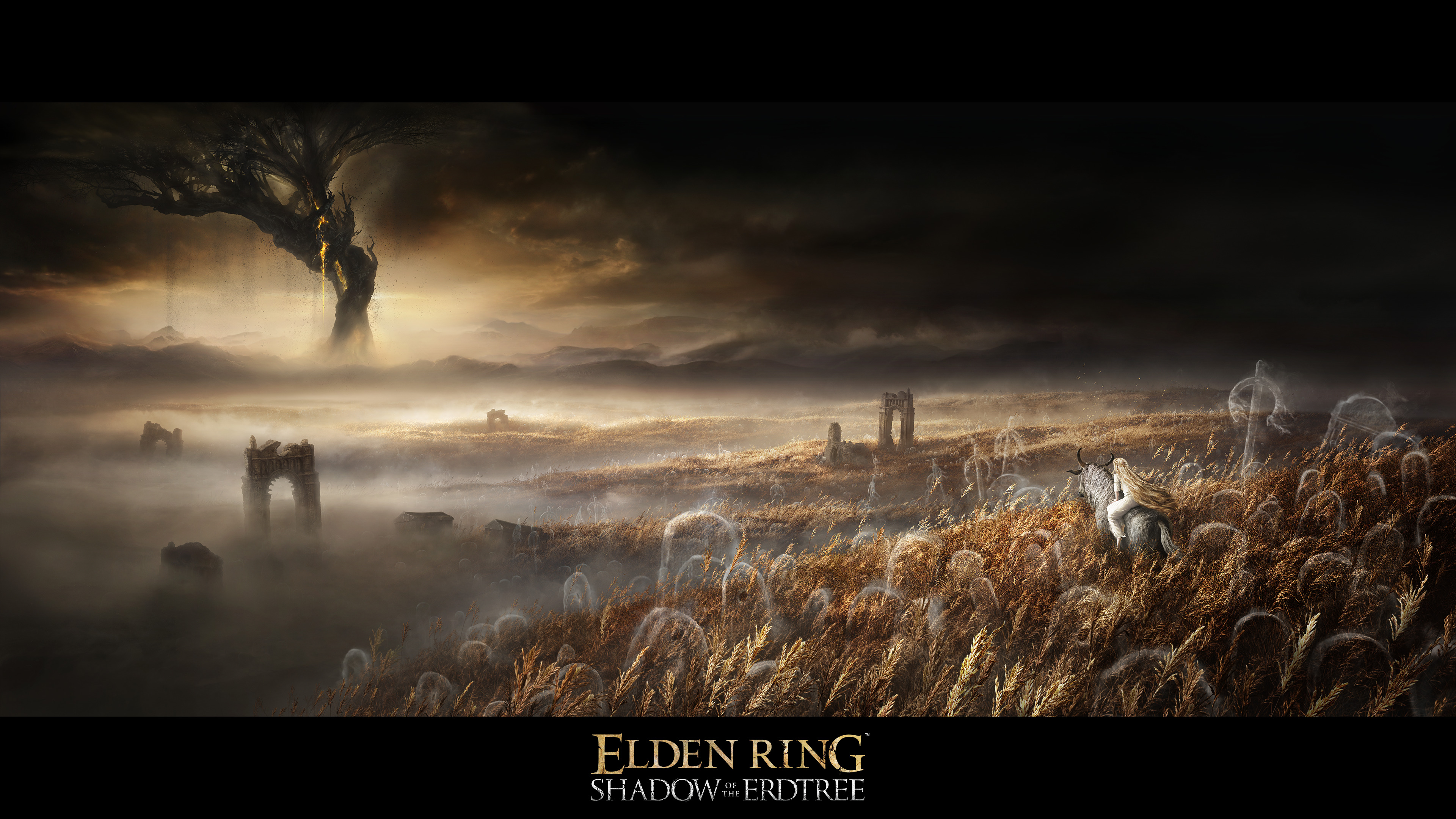
Still, I'm super excited for more Elden Ring. The only bit of info, as far as I know, about the expansion is this image:


So, what do we see here?

First, we've got something that looks like a burned-out, broken Erdtree (or another tree - it could even be the Haligtree, though the title seems to imply it's the Erdtree) in the background, with some kind of golden light or sap dripping from it, along with darker dust, ash, or something.

We're on a field of what looks kind of like wheat, out of which spectral stones and these kind of rounded crosses are rising, and then what appears to be Torrent carrying a long-haired blonde figure in white with braided hair. My immediate guess is that this could be Miquella, though they seem more adult than the "cursed to eternally be a child" demigod. That said, some of what Gideon Ofnir says when you find Miquella in the cocoon with Mohg implies that he might not be dead, but could still be developing and metamorphosing - maybe Miquella will be able to grow to adulthood.

There are also these ruined archways in the fields here - each arch seems to have a similar design, though some are part of larger building structures and some appear to stand on their own.

Obviously, piecing together the context of all these images is a big part of the joy of these games' lore. I'll keep an eye out for details.

Saturday, February 25, 2023

Sci Fi Storytelling for Starfinder and Spelljammer

 I'm a big fan of both Science Fiction and Fantasy as genres. I spent my childhood in the 1990s, which was a period in which there wasn't really a lot of fantasy-genre stuff. The 80s (the decade I was born in, though I was only about three and a half by the time 1990 came around) had seen a ton of fantasy movies, but a few things, I think, pushed the 90s more toward science fiction. First, you can't ignore the growing presence of computers in daily life. My dad's a professor of computer science, so I think there was never a time while I was around that we didn't have a computer in the house, but the idea of having a computer went from a somewhat rare thing to basically universal by the year 2000. The Internet and specifically the World Wide Web (a term people don't really bother with anymore, but specifically this thing that you access via web browsers, and upon which you're reading this blog, as opposed to, like, email) exploded in use and popularity.

At the same time, the popularity of Star Wars, and the Star Trek films, which started in the late 70s and were at their height in the 80s, the latter of which then spawned Star Trek: The Next Generation, which itself helped to inspire a number of other popular spacefaring sci-fi shows, meant that the public was thinking sci-fi a lot. Furthermore, the 90s was a period of space exploration - the Hubble space telescope and the Pathfinder Mars mission made it look like life in space was just around the corner.

I think it was probably the Harry Potter series (books and movies) and especially the Lord of the Rings movies that came out in the early 2000s that elevated Fantasy to similar heights. (It's crazy for me to think that it's been longer between now and Return of the King than it was between The Fellowship of the Ring and Return of the Jedi.)

As a consummate nerd, then, I've sort of tilted back and forth between the genres. My household, particularly from my Dad's side, was always very rational. We weren't religious (at least not spiritually - I still feel a strong cultural connection to my Dad's Judaism and my Mom's Catholicism). My sister likes to joke that our religion growing up was Star Trek, and certainly I think the optimistic humanism of that series remains very appealing to me.

This is all a very winding road to lead to the following discussion:

Immersed in the fantasy landscape of D&D for many years now, I've been itching to try out some sci-fi roleplaying. And I'm finding that inspiration is a little harder to come by.

I think there are a couple reasons for this.

Fantasy, ultimately, is the genre where literally anything can happen. You're unbound by just about anything because you can literally say a wizard did it (or a god, or something else). Sci-fi at least requires some internal consistency, though admittedly you can always invoke Clarke's Law about sufficiently advanced technology being indistinguishable from magic.

Still, there's this other issue: Fantasy has a lot more kind of "public domain" tropes. Tolkien codified the classic fantasy elf, but he didn't invent them. Dwarves, orcs, goblins, and any manner of existing folklore creatures from any culture are fair game for fantasy.

Sci-fi, though, tends to expect novelty. Whether you're going for the deeply alien entities from 2001: A Space Odyssey or Arrival, or for more human-like ones like the Vulcans of Star Trek, there's not generally a list that any casual fan of the genre could point to and say "oh yeah, those are the classics."

For example, if you look at the default playable races in Starfinder, Humans and Androids are really the only ones you could show to people and expect them to immediately get the basic gist of them. Kasathans, Vesk, Lashunta, Shirren, and Ysoki all require an explanation.

Compare this even with Pathfinder's main races: Dwarf, Elf, Gnome, Half-Elf, Halfling, Half-Orc, and Human. While Halfling is arguably more specifically tied to Tolkien (and haven't become as universal as Orcs have) you can probably expect any casual fantasy fan to know what you're talking about with these (the most explanation you'd need for Halfling is "oh, those are Hobbits").

Now, sci-fi does have its own popular tropes for villainous threats, but I think it's relatively straightforward to say "this adventure is about fighting the undead" or "this one has a mad wizard" or "this one has a demonic incursion" or "this one has you slaying a dragon."

Often, science fiction builds itself around a novel conflict and trying to logically determine how people would respond to such a thing.

Now, one fallback that one gets to enjoy with both Spelljammer and Starfinder is that both of these still take place in a fantasy universe. Fantasy often puts these sort of arbitrary limits on technological development - as if magic and technology up to a certain level couldn't co-exist. But by embracing the science-fantasy hybrid genre, it actually gives you a bit of an out - you can still tell stories about undead legions, demonic incursions, mad wizards, and rampaging dragons. Just, this time, rather than slaying the dragon with a legendary sword, you can shoot it with a rocket launcher.

Honestly, I don't know if I have much of a point so much as I'm walking myself through how to tell a story in a sci-fi setting.

Friday, February 24, 2023

Paladin Analysis - Smites

 So, compared with the Druid, which saw a huge overhaul to Wild Shape, Paladins are looking pretty similar - getting changes that I think are roughly on par with the Rogue, i.e. slight tweaks. Paladins are, of course, already a very popular and well-designed class.

Some of the changes are really semantic ones - you now only have a single Aura of Protection, but features that would grant you other auras like Aura of Courage or Aura of Devotion now simply add that functionality to Aura of Protection, which basically winds up meaning to real change (though it allows for simpler templating on things like Holy Avenger weapons).

I think we can also talk about how the Paladin now has spellcasting at 1st level and access to cantrips. Without things like Green-Flame Blade, though, I think Cantrips are unlikely to be super impactful (though the new Spare the Dying could replace the old "1 hit point of Lay on Hands to pop you up").

In theory, this is meant to make Spellcasting a more prominent feature for the Paladin, but I honestly think that other changes are more likely to make the difference, which we'll get to.

Let's get to the meat of it, though: Divine Smite has seen some changes. For existing Paladins, this will take the form of a nerf, but it's a light enough nerf that the core fun of the mechanic is not diminished.

The new version of Divine Smite now lets you expend a spell slot when you hit with any attack roll while using a weapon or an unarmed strike (as a note, grappling and shoving with an unarmed strike no longer involves an attack roll, so you can't put this damage on those functionalities). You deal additional radiant damage to the target, getting 2d8 for a 1st-level slot, and adding 1d8 for each spell level higher than 1st. You can do this no more than once per turn, and you can't use it on the same turn you cast a spell.

So, let's break down how that's different:

The nerf here is the limit to once a turn, and being unable to use this on the same turn as a spell. You can thus almost imagine that Divine Smite is like a spell itself. The other nerf is that you no longer get a bonus d8 for hitting an undead or fiendish target. This one makes me a little sad, but I also think would be the least broken to revert, so we'll see how this evolves.

However, the buff here is that you can now Smite on Unarmed strikes as well as on ranged attacks. Previously, Paladins were limited, like Barbarians and Monks, to being melee combatants. With the changes to many Smite spells with the introduction of the Battle Smith Artificer, the possibility of a ranged paladin started to get a little more viable, but Divine Smite really held them back. With this change, there is nothing, as far as I can tell, that prevents you from making a Dex-based, ranged Paladin. You also get access to all the Warrior Fighting Styles, so there's nothing preventing you taking something like Archery. Radiant Strikes, the renamed Improved Divine Smite, only cares that you attack with a Simple or Martial weapon to get your bonus d8 of radiant damage, so there's really nothing here preventing you from building the Paladin this way.

Also, there's no limit to how high the Divine Smite damage can go. If you are a pure caster who puts two levels into Paladin, you could potentially toss a 9th level spell slot to do 10d8 radiant damage when you hit (probably only if you crit, which, at 20d8, comes out to an average of 90 freaking damage).

Also, if you do a Monk/Paladin multiclass or otherwise build around Unarmed Strikes, you can now smite on those too, which I think is more niche, but still cool.

Another note here is that the way that "Smite Spells" have changed is that they no longer require you to pre-cast them. You can cast Searing Smite after you know you've hit. As such, these spells now have that great benefit of being able to choose when to use them when it's most advantageous. Now that the opportunity to cast these spells is exactly the same as the Divine Smite feature (sort of - they do technically take a bonus action still, so if you've used some other feature that takes a bonus action, such as Oath of Devotion's Sacred Weapon, you'll only be able to do Divine Smite) you'll now be making a tactical decision of whether the utility of the spell is worth losing the damage of the Divine Smite.

For example: Glimmering Smite is a 2nd level spell that causes your attack to deal 2d6 extra radiant damage and then dispels invisibility and causes the target to glow for a minute and gives attack rolls advantage against it. So, we're talking 3d8 versus 2d6 - meaning about 13.5 on average versus 7 - but then potentially a minute of advantage against it. Unlike Faerie Fire, you already know this has hit, so you can count on this effect being applied. The loss of 6.5 damage to start might be worth it if you're now giving your party a much better chance to hit the thing (especially if it likes to go invisible).

Now, this definitely means that you'll not be able to nova as hard as you can currently. You can't burn two 2nd level spell slots on a turn to put in 6d8 extra damage. This also means that if you burn a smite on a normal hit with your first attack, you run the risk of wasting a crit without smiting on your second attack. Essentially, I think this is going to push Paladins to be a bit more conservative with their Smites.

That is, honestly, probably by design. Paladins unleash nova damage like no one else (except maybe Rogues, but that's the whole basis of their combat strategy). This doesn't ultimately reduce the Paladin's damage output per day, even if it does nerf their damage output in early rounds of combat.

Actually, one little nuance worth considering: you can't Smite on a turn you've cast any spell, not just "of 1st level or higher," so this does potentially kill some sort of Booming Blade/Smite combo? Well, yes - though interestingly, you could still do a Booming Blade/Thunderous Smite combo (the target still needs to willingly move to get the punishment damage on Booming Blade, but they probably will if they want to stand up from prone - obviously, Booming Blade is not a Divine spell, but if you get it somehow like via magic initiate, you're gold).

Personally, I'm not upset about this, even if it is a nerf (and let's be clear: nerfs are necessary for game design or everything goes into full power creep mode, which is less fun). Yes, you won't be able to front-load a ton of damage here, and the once-per-turn might make you a little more trigger-shy, but Paladins are still probably going to be one of the best classes out there, and one that will bring some major pain to their foes.

Now, let's talk about the positive changes:

Even if you're still going with a Strength-based classic Paladin (which I suspect will remain the most popular build,) being able to smite on thrown weapons will give a bit of ranged versatility. Divine Smite, Smite Spells, and Radiant Strikes will all work on these. which is not the case with the current rules.

But this also frees you up to build a full ranged-based Paladin. You can pick up the Archery Fighting Style and fight with a bow (or, as I'm really picturing it, a gun - it remains to be seen whether firearms will be a prominent choice in One D&D or if they'll still be stuck in the DMG). Your Aura will still be up, though likely protecting other ranged characters instead of melee. Basically, all of your class features can work just as well at range as they do in melee, thanks to these changes.

Interestingly, the primary abilities are still Strength and Charisma meaning you need at least 13 Strength to multiclass into Paladin - which is odd given that you could easily make a level 1 Paladin with a negative to Strength if you want to go this route, but that's actually the same as current (I've seen finesse paladins who use medium armor and a rapier).

Again, I see far less need for further iteration here than on the Druid. There will surely be outcry, but I think the nerf to Divine Smite again is not a huge one, and is probably warranted.

Druid Analysis - All About Wild Shape

 Ok, let's get some opinions out there.

Looking at the comments on Jeremy Crawford's twitter and the Youtube video where they discuss the Druid, you'd think that no one whatsoever is a fan of the Druid revisions in the latest UA. It remains to be seen whether that opinion is held by the people who take the Survey - both being avenues by which the team looks for feedback.

Before I get into what I think about these changes, let's try to reverse-engineer the intentions behind them. Then, I want to look at the ramifications of the changes as they are, and then we'll see how they match up with the intentions.

(As a note, I don't think I'll have as much to go into with Paladins, who frankly got a slap-on-the-wrist nerf to Divine Smite but an expansion to its functionality that will be a huge net positive to the class.)

Wild Shape is the iconic Druid ability. But it's also one of the old abilities that requires a player to either have access to a book the DM might be using to run a game or that they'd need to keep separately. It's an ability that expands endlessly as new books with new stat blocks are published.

So, the use of three set stat blocks is, I think, clearly intended to make this feature easier to use. The player can be expected to have copies of those three, and chooses the one that's appropriate for the situation.

Furthermore, by making these stat blocks generic as simply "Animal of the Land, Sea, or Sky," it encourages players to be creative - I might ask a player "so, when you transform into this dire wolf, what does it look like?" and get back "well, it's a big wolf," because they might not yet know the degree to which you can reskin things in this game. Here, that open-endedness is inherent.

Furthermore, as it currently stands, the highest CR you can get if you're not a Circle of the Moon Druid is CR 1. I believe part of this change is to make fighting in Wild Shape a more viable option for other subclasses.

I believe the intent here is to basically let players shift into forms equivalent to Circle of the Moon's regardless of subclass. Obviously, that's the case given the new Circle of the Moon, but we'll look at how it compares to the previous version.

Now, let's address the other thing here: I have to assume this is intentional because it's such a huge change: Wild Shape previously allowed you to effectively stack on a massive amount of extra HP. And I think that has got to be an intentional nerf.

Ok, so let's look at the ultimate ramifications of these changes.

First off, unquestionably, Wild Shape is going to be simpler to use. The stat blocks presented give some good, basic functionality, but you're not going to have any really weird, nuanced things that come from picking odd stat blocks. Here's the thing: this is going to be a welcome change for more casual players, but the deep theorycrafters will not like it. There's subreddits and things dedicated to optimization that will have fewer things to discuss if Wild Shape is shrunk down to three subclases, and people who love tinkering with "well, if we turn into this "Slyzlak" from this 3rd party monster book, we can pull off XYZ" will no longer be able to do such things. But, for what I imagine is most players, it'll be much easier to say "ok, I get it" when looking at the ability. Frankly, I think that's more valuable to me. Sometimes, limited options can force greater creativity.

Next, let's look at how this stat block compares with comparable beasts for a Druid to shift into. As it currently stands, by level 8, a non-Moon Druid can shift into a CR 1 creature at level 8. A Dire Wolf is a common choice. This is the cap for non-Moon Druids in terms of CR.

The Dire Wolf has an AC of 14, 37 HP, and a single bite attack with a +5 to hit and which deals 2d6+3 damage. It does have pack tactics and keen hearing and smell, and the attack forces a strength save or the target goes prone.

A level 8 Druid in the new system who takes on an Animal of the Land form (say, as a Dire Wolf) who has let's say +4 to Wisdom (with the new feats they might not have it capped out at 8) and +2 to Constitution would have an AC of 14, 67 HP (though that's total, not just the animal form.) They'd have Keen Senses (which is actually better than the Dire Wolf) and they'd have a climb speed of 40 feet and two Bestial Strikes with a +7 to hit that each deal 1d8+4 bludgeoning, piercing, or slashing damage.

So, this is clearly a more powerful form, again with the exception that it's not more HP on top of their normal form. Now, a Moon Druid could get a CR 2 creature at this point. Let's say a Polar Bear. This has an AC of 12, 42 HP, Keen Smell, and a multiattack with +7 to hit, one of which does 1d8+5 and the other doing 2d6+5. So yeah, the AC's a bit lower, but the Polar Bear is maybe putting out a bit more damage.

Still, I think we're in a similar ballpark, which means the intent is kind of fulfilled.

Now, the next question is this: is the lack of separate HP going to utterly tank this as a feature?

In other words, can a Druid expect to be a front-line combatant when they take on their Wild Shape?

Because when it comes to the class fantasy, that's definitely high up there. You want to hop into the form of some large beast and maul the monster.

I would argue that this nerf has made that less possible, possibly prohibitively so.

So, we haven't yet seen what the Monk looks like in One D&D, but they're a class that has also suffered a bit from an identity crisis. But let's compare this with heavily-armored Fighters, Paladins, or the less-armored but still tanky Barbarians.

With heavy armor, you basically start off at an AC of 16, and can get that to 18 with Plate, adding 2 with a shield, meaning a range of 18-20 (before we get into fighting styles and magic items). Fighters and Paladins also get a d10 hit die, meaning on average one more HP per level than a Druid. Barbarians get a d12, so two more per level.

Outside of epic boons or quite rare magic items, the Druid's armor class in Animal of the Land or Sea form is going to cap out at 15 with a +5 to wisdom, and only hits 13 in Animal of the Sky. This means they're going to be way easier to hit. To be far, Animal of the Sky has Flyby, so unless dealing with ranged or flying monsters, you can probably do hit-and-run attacks. But our Animal of the Land, which is theoretically meant to be the one that's really most focused on tankiness, still caps at 15 AC (lower than a level 1 Paladin in Chain Mail and nothing else) and with no bonus to your HP, means you've got no more HP than a Rogue, Warlock, or Bard.

Now, I fully understand if the developers wanted to reduce the power of Wild Shape's HP pool - as we saw in a previous post, a Moon Druid who goes into Fire Elemental form is getting over 100 more HP. And even a non-Moon Druid who becomes a Dire Wolf is getting 37 extra, which is pretty substantial.

But surely there must be a middle-ground. What I might recommend is that when you Wild Shape, you get Temp HP equal to either twice or three times your Druid level. Basing it on Druid level will help reign in crazy multiclass combos like the Druid/Barbarian Rage Bear, but still lets the Druid feel a bit tankier.

Next, the very simple fix here is to just raise the base AC of the Wild Shape stat blocks. At +5 Wisdom, I think it's not unreasonable to allow for an AC equivalent to nonmagical plate. So, let's make the Animal of the Land at least have an AC of 13 + Wisdom. Level 8, when you can get a Druid's Wisdom to 20, is around the time that a heavy armor character can afford plate armor, so it works out.

And honestly, Druids wouldn't need much more - you still have the huge Primal Spell List to complement this power. I think it's ok that the Wild Shape form isn't quite as powerful as a true Warrior class, but your spells make up for the deficit.

The last thing I'd address is the Tiny form. There is absolutely no reason this can't come before 11th level. This should be like level 2, if not simply part of the level 1 Wild Shape trait in the first place.

Naturally, I'll be floating some of these ideas when the Survey goes live at the end of the month, but there's my thoughts.

Thursday, February 23, 2023

One D&D Druids and Paladins: Miscellaneous Other Stuff

 As usual, the UA rounding out the Priest classes (hey, we're halfway through the PHB classes!) has more than just the classes themselves. Let's take a stroll through these things:

Epic Boons Get More Epic:

With class features now capping out at level 18, all classes now get a special Epic Boon feat at level 20. However, what has been added to this is that, in addition, you now get a +2 to any ability score, and rather than capping at 20 in that score, it now caps at 30, meaning that everyone can get a +6 in their primary ability. (We'll have to see if Barbarians still get the +4 to Strength and Con, but if they do, a level 20 Barbarian could potentially have a 26 in Strength at level 20, which is pretty sweet.)

Additionally, Epic Boons now, like 4th level feats, come with an ability score increase (though just one point,) meaning you're actually getting a total of three extra points to your scores. This is also capped at 30, so if you have a really extended max-level campaign in which you get multiple epic boons, you could potentially get a +10 to a score. Unlikely, but cool.

We only got three feats, which have gotten the following revisions:

Epic Boon of Fate is actually worded in a funny way that might be an error - if a creature within 60 feet of you fails a d20 test, you can roll 2d4 and apply the total as a bonus or a penalty to the roll once per turn, with 8 charges and regaining 2d4 charge when you finish a long rest. I have to imagine that it is meant to also work on successes, because otherwise applying a penalty to a check already failed could only help if there's a more severe effect for failing by 5 or more - which players tend not to impose. Additionally, you get a 1-point bonus to your choice of Intelligence, Wisdom, or Charisma (max of 30).

Epic Boon of Spell Recall also buffs Int, Wis, or Cha by 1 and each time you cast a spell with a spell slot of 1st, 2nd, 3rd, or 4th level, you roll a d4, and if the number you roll is the spell's level, you don't expend the spell slot. I actually like this a lot, though I worry it might not be popular because anecdotally you'll have a lot of times where it doesn't help at all. By 20th level, getting more 4th level spells isn't going to be game-breaking. In the long run, this should give you an average of 25% more low-level spell slots, which could be really nice to free up some utility, though I can imagine it being very sad when you don't get any free slots in a day. (We'll have to wait and see how Warlocks look in One D&D, because in theory, while this is available to Priests and Mages, a Warlock won't have any spell slots this low by level 20).

Epic Boon of Truesight is very simple: you get a +1 to Int, Wis, or Charisma, and you get Truesight out to 60 feet. This is identical to the previous version in the Cleric UA other than the ability score bump. I think this is actually a very cool and simple feature, so all good.

Spell Changes:

First off, as a reminder, most healing spells are now considered Abjuration, which is important for Circle of the Moon Druids, who can now cast Abjuration spells in their Wild Shape forms (without having to wait for Beast Spells at high level).

Paladins are going to be looking at a very big and welcome change to Smite spells. The casting time now is officially a "bonus action which you take immediately after hitting a creature with a weapon or unarmed strike." In the current system, Smite spells are odd in that they're concentration spells that you have to cast before you attack, meaning that if you miss, you can actually potentially lose concentration if you get hit before you hit with your attack. Likewise, they don't get the benefit Divine Strike has by letting you wait for a critical hit. But all of that has changed! Now, you basically make the decision the same way you would a Divine Strike, though of course you can't stack them now.

I actually think this is a great change. Divine Smite will remain the highest damage option, but now the only penalty for picking one of these spells instead is lower damage (and preparing the spell, though I expect a lot of Oaths to have these as oath spells). These thus become more reasonable tactical choices, and allow you to make the decision when it's most pertinent.

Now, Spare the Dying has potentially gotten a huge buff, though that depends a bit on interpretation. The cantrip (which, remember, Paladins can now take) now restores 1 hit point to a creature with the Dying condition. We're going to have to unpack that. If this works as it would by current rules, that's freaking enormous. However, we need to look at the way the new Dying condition works, though I think it's still open to interpretation:

When you hit 0 hit points, you have the Dying Condition. If you regain any Hit Points while Dying, this condition ends (seems straightforward). While Dying, you are "knocked out" and have the Unconscious condition (which we'll unpack below). At the start of each of your turns, you make a Death saving throw. These work the same as they did, except: when you succeed at a total of 3 death saves, you regain 1 hit point, ending the Dying condition, but you remain Unconscious and begin a Short Rest. You remain Unconscious until you regain any Hit Points or another creature uses an action to administer first aid to you, which requires a DC 10 Wisdom (Medicine) check. If you take any damage while Dying, you suffer a failure of a death save, or two if it's a critical hit.

Now, let's look at Unconscious: You have the Incapacitated and Prone conditions and drop whatever you are holding. Your speed is 0 and can't change. Attack rolls against you have advantage. You automatically fail Dex and Strength saving throws. Any attack against you that hits is a critical hit if the attacker is within 5 feet of you. And you are unaware of your surroundings.

So, backing things up: I think you only remain unconscious if you regain the 1 hit point by succeeding at Death saves. Thus, Spare the Dying now fully wakes you up, allowing you to get back into the fight. This makes this cantrip way, way, way, way more powerful. Essentially, the 2014 version is only really useful if the healer is completely out of spell slots and the fight's almost over (or is over,) unless you're a Grave cleric and can cast it at range as a bonus action. This, though, is basically the old "1 point of Lay on Hands to wake up an ally" that a lot of Paladins use, but as a cantrip that never runs out. This spell got a lot better, and might now be a go-to.

I made a whole post about Find Familiar and Find Steed, so we'll skip that one.

This UA includes a changelog for the Rules Glossary, which is really useful for this kind of review, even giving us some insights into the actual changes.

First off, we have new definitions for the Dying Condition (as seen in the Spare the Dying discussion,) Knocking a Creature Out, Short Rests, Telepathy, and the Unconscious Condition (likewise discussed above).

Knocking a Creature Out is now an option for any melee attack (which would seem to include spell attacks that are melee-based, so have fun Inflict Wounds-ing someone to sleep). When you do this, you can choose to reduce the creature to 1 hit point instead of 0, and then give them the Unconscious condition, during which they begin a Short Rest. They remain unconscious until they regain any hit points or someone administers 1st aid to it with a DC 10 Medicine check.

The gist here is that 1 hit point is kind of standing in for "stable at 0 hit points" as it was in the 2014 rules, but seems to more or less work the same.

A Short Rest looks pretty similar to its current iteration, but we get the following things to officially interrupt it: rolling initiative, casting a spell that's not a cantrip, or taking any damage, and unlike a Long Rest, which can take a short interruption lasting less than an hour, and interruption to a Short rest will require you to start it over.

Telepathy gets cleared up a little: you don't need to share a language to speak telepathically, and even if only one member of the conversation is telepathic, you can both communicate to one another. Only a telepath can initiate the conversation, though. If a creature is not telepathic itself, it needs to understand at least one language for you to have conversation with it. Seems pretty straightforward.

Now, a few entries have been revised:

On D20 Tests, you no longer automatically get Heroic Inspiration (now renamed Heroic Advantage) for rolling a 1 - it's back to being DM's discretion or a Human racial trait.

This one's huge: your allies are no longer Difficult Terrain. No more leapfrog nightmares in narrow corridors! Also, furniture is difficult terrain if it's a size smaller than you or larger.

The rules on Equipping weapons have been clarified: this can mean drawing it from a sheathe, picking it up, or retrieving it from a container, and you can do this before or after each attack you make as part of the attack action (you can also unequip it, meaning sheathing, stowing, or dropping). Basically, the rules get out of the way here, which is great.

Fly Speed has had the circumstances in which you fall defined as being, when you lack the Hover trait, getting Incapacitated, being Prone, or having your speed reduced to 0. I'm not sure I remember how this differs from the previous version, but I'd assume it's the 0 speed thing. Makes logical sense.

The Grappled Condition has been somewhat reverted in that you once again need to make a Strength (Athletics) or Dexterity (Acrobatics) check to escape a grapple as an action, though this happens automatically if the grappler is incapacitated or if the distance between you and the grappler exceeds the grapple's reach. The "save at the end of your turn" version of this made being grappled less scary, so this might be for the best. A lot of the other new changes (like imposing disadvantage on attacks against those other than the grappler) are still there. The grappler no longer gets the "Slowed" condition (which has been removed) and instead expends an extra foot of movement for each foot they move while grappling you unless you're Tiny or at least two sizes smaller than the grappler.

The Help Action now also allows you to help if you have a relevant Tool Proficiency, in addition to Skill Proficiencies.

Heroic Advantage is the new name for Heroic Inspiration, and is now back to being primarily awarded at DM's discretion, with no automatic gain for rolling a natural 1.

The Incapacitated condition now clarifies that you also don't get Bonus Actions.

The Long Rest has gotten a lot of little tweaks. In specifies that if you're sleeping (which you need to do for 6 hours of the 8) you have the Unconscious condition. You cannot benefit from a Long Rest until you've spent 16 hours since your last one (which comes around to meaning no more than one in 24 hours). Interruptions include rolling initiative, casting a spell higher than 0th-level, taking any damage, or 1 hour of walking or other physical exertion. If the rest lasted at least 1 hour before the interruption, you can take the benefits of a Short Rest, and if the Long Rest is interrupted, you can resume the rest immediately, taking one extra hour per interruption.

Notably, this means that you don't have to start over entirely if your interruption lasts more than 1 hour, as it did in previous UAs. None of this stuff is particularly mindblowing, but it's good to get it all clearly delineated.

Moving has gotten a couple changes: as before, your allies are no longer Difficult Terrain - neither are Tiny or smaller creatures. So yeah, that's massive and really great for when your party is stuck in a narrow corridor and the melee folks are in the back. Also specified is that any changes to your move speed are also applied to your other speeds.

Finally, Unarmed Strikes only use an attack roll when you're trying to do damage to them. If you want to Grapple or Shove a target, the target makes a Strength or Dexterity saving throw (their choice) against a DC equal to 8 + your Strength modifier + your Proficiency bonus. You also can't grapple or shove a target that is more than one size larger than you, and you need a free hand to grab a target if you want to grapple.

We're still of course waiting to see the One D&D Monk, but I hope that they get to change this DC to be based on their Dexterity so that they can use these maneuvers effectively.

Finally, we've seen the following entries removed from the Rules Glossary. Naturally, some of these are still in the game (remember that anything not listed here is assumed to be the same as in the 2014 PHB) but some of the new concepts are gone. These include:

Ability Check (obviously still a thing, but ignore what was written before).

Attack Roll (ditto)

Climbing and Swimming (the oddness of using these speeds for walking is probably getting reworded)

Dash (curious to see what was wrong with the previous One D&D version, which I thought was just an action to Move again)

Hidden (yeah, this had issues. The surprising thing is that the Hide action having a flat DC of 15 is still there)

Jump (this one I'm happy to see go, as it prevented attacking after you jumped across a crevasse, which seems wrong)

Slowed (I actually thought this was cool, though condition bloat is a real thing - holy crap there are so many conditions in Starfinder)

Special Speeds (I imagine they're working out new wording to get the nuances of Climbing, Swimming, and Flying speeds clear).

Anyway, a lot of stuff to chew on in this UA. And I'm very happy to have more to look at. We're kind of in a moment where a ton of companies are working on their own RPG systems - I've seen Kobold Press' Project Black Flag, which has a conservative approach that looks very similar to 5E, but then MCDM just officially announced what they'd already been talking about, which is an RPG system that they want to make from scratch that will probably feel very different. And while I'm eager to try new things, I'm also very excited to see this refinement of 5E D&D that is about 95% stuff I'm very happy about.

While we've now done the exhaustive deep-dive on this UA, I'm sure that new nuances and thoughts I have will pop up. I'm still ravenous to get the Warrior and Mage classes in hand (and I'm particularly curious about the tantalizing Design Note that says "the Shortsword (Simple) and the Scimitar (Martial) will have different roles to play in the game," and the way that weapons appear to have clearer distinctions in their functionality moving forward - right now a Longsword and a Battleaxe are functionally identical other than weight and cost, but that might change). I think it'll probably be a bit before we get those, but hopefully not too long.