For whatever reason, I'm not really into the "harmonious nature" type fantasy class archetypes. I like the primal, elemental power of WoW's Shamans over their Druids, for example. This extends to D&D, where I tend not to be all that into Rangers or Druids.
However, in a couple post-Player's Handbook publications, we got some new options that give me a vibe I'm more into - adding a little horror to nature. Druids get their Golgari-themed Circle of Spores in Guildmaster's Guide to Ravnica, which I have been mulling over for a while to have a druid character who was raised by a coven of hags (and who wears a big stag-skull headdress like in this one educational movie I saw in 6th grade) and really has to learn what being a good guy is.
But, similarly taking "the woods" to mean the dark, scary version of said forests, I've often thought that a wandering monster hunter would be a really cool character type. I guess a bit like a Witcher.
Now, I came up with a backstory for a Vengeance Paladin who would fit this archetype (trying to go a little outside the box with a Chaotic Neutral paladin) though given that I wound up playing my Eldritch Knight Fighter as a Dragonborn, I now think that the story I had for a Warforged one would fit for a (more traditionally heroic) Paladin, which has kind of shifted my backstories down the line, meaning that this monster-hunting paladin could be a Ranger instead - which certainly fits, especially with the Monster Slayer class archetype.
Now, Monster Slayers come with a number of features, of course, but early on you get "Slayer's Prey," which is essentially an infinitely-refreshable Hunter's Mark. It's not a spell, and while it'll wear off of your current target, you can always put it on someone else if you have a spare bonus action - no rest required.
Unfortunately I'm on vacation and left Xanathar's with my roommate, as he runs a game (there's a lot of D&D at our place) so I don't have access to the exact rules in front of me (and I'm not going to re-buy the books I have on D&D Beyond, sorry) but I had the following thought:
Because Slayer's Prey and Hunter's Mark are not mutually exclusive, if you got both up you could have a 2d6 bonus to damage with each attack. So, how could you maximize that damage?
One option would simply be to dual-wield shortswords and be a melee ranger. Another option is to go Crossbow Expert and use a Hand Crossbow. The trade-offs:
Melee means being in melee, which is more dangerous. Now, a Ranger is certainly tougher than most classes, being a d10 class. Also, if the DM is a stickler, you might have to drop your off-hand sword in order to cast Hunter's Mark for the somatic components. You'll also need to go with two weapon fighting, which is fine, but something you won't need to worry about if you go the other way.
With a hand crossbow, you'll really need the feat for it to work, but a lot of the disadvantages disappear: without loading, you can fully use the crossbow without interruption. You can also use it in melee without any disadvantage. And you'll also be able to shoot twice - action and then bonus action (and then 3 once you hit level 5.) You will need to stock up on bolts, but that's not terribly hard to do. Now, I believe that the bonus attack you get with Crossbow expert does use your Dex modifier, unlike typical off-hand attacks (though I might need a rules clarification there.) If it doesn't that means the shortswords with two-weapon-fighting give you a little more damage, but either way, you'll be freed up to take Archery, which will mean you hit more frequently and get all those bonus dice.
And the idea here is to try to hit as frequently as possible to take advantage of the bonus dice. For that reason you might even consider multiclassing into Fighter to get Action Surge, even potentially making the character primarily a Fighter (though I'd stick with Ranger for flavor reasons.)
The downside to this build is that it takes a long time to ramp up.
Given that hand crossbows and shortswords both deal 1d6 damage, I'll kind of merge them, but let's look at the possibilities as compared to using, say, a heavy crossbow (we'll still have crossbow expert so that we ignore loading.) We'll look at this at level 3.
Turn One:
Hand Crossbow: Bonus Action: Slayer's Prey. Action: Attack for 2d6+Dex (average dice damage: 7)
Heavy Crossbow: Bonus Action: Slayer's Prey. Action: Attack for 1d10+1d6+Dex (average dice damage: 9)
Turn Two:
Hand Crossbow: Bonus Action: Hunter's Mark. Action: Attack for 3d6+Dex (average dice damage: 10.5)
Heavy Crossbow: Bonus Action: Hunter's Mark: Action: Attack for 1d10+2d6+Dex (average dice damage: 12.5)
Turn Three:
Hand Crossbow: Action: Attack: 3d6+Dex. Bonus Action 3d6+Dex (again, can't remember if you get this bonus twice.) (average dice damage: 21)
Heavy Crossbow: Action: Attack: 1d10+2d6+Dex (average dice damage: 12.5.)
So as we can see, if you get to turn three and the thing's still alive, the hand crossbow build starts seriously delivering. Admittedly, once you get Extra Attack at level 5, the Heavy Crossbow build is going to catch up a bit, but that'll mean essentially 2d10+4d6 versus 9d6, meaning 25 versus 31.5. And if you get to add Dex an extra time with hand crossbows, that bonus expands significantly.
The problem, of course, is the ramp time. Even if the average dice damage for turn 3 is much higher than that for the heavy crossbow, the first couple rounds you're doing more with the heavy crossbow - and you need to refresh all these effects for every enemy you fight. So while ramping up might be a good call against a giant monster with a boatload of hit points, if you're going after just a few skeletons or something, you'll never get enough time to build up to that point.
In which case, it's probably up to the Ranger to decide whether it's worth marking up the target or simply just unloading on them. The only benefit of that hand crossbow is the bonus attack. Now, if you can work out with your DM that you've maybe got your Heavy Crossbow on a strap so you can drop it as a free action (without potentially losing it on the battlefield) and then use your item action to draw the Hand Crossbow, you could use the Heavy while marking things up. But if the marks aren't going to last very long anyway, you could also consider dropping one (say, Hunter's Mark, given that it's a spell slot) and double-tapping earlier.
Assuming your DM does not want you swapping willy-nilly, and you have to take the time to draw and stow, it'll be a judgment call for the Ranger to decide how long things are likely to live. Against a group of low-CR monsters like skeletons, goblins, or blights, you might simply double-tap with the hand-crossbow. That being said: if the bonus attack with Crossbow expert does not add your Dex modifier, you might be better off using at least Slayer's Prey - given that a d6 is all you'd be getting anyway with that other attack - and then future attacks would be buffed as well (giving you 2d6 on the next turn, if the thing survives.) But if you have a guaranteed 3 or 4 Dex modifier damage, you'll want that instead.
Now, I haven't even gotten into other class features and such, but the point here is that at fairly low levels, you can dish out a rather massive amount of damage to something if it lives long enough.
And a Monster Slayer of this sort I think works very well for a tier 1 range. The character is the sort of person who goes from town to town, is likely feared by the locals but they put up with them because this is the sort of person who gets rid of the really scary monsters that terrorize their village.
Variant Human is probably a good choice for both flavor reasons (Humans work well, I think, for gothic horror) and because you'll get your free Feat, so you get Crossbow Expert at level 1. The backstory I've got written is for an Aasimar, which I think could work flavorfully (the backstory merges his "haunted" background with the corruption of his angelic guide by a demon, making him a fallen aasimar, though the Strength bonus was more useful for a Paladin.)
To fit in with the theme, I recommend taking Undead or Monstrosity as your first Favored Enemy, and then eventually picking up Fiend (though Fey works pretty well if you've got Hags to fight.) Favored Terrain will probably be Forests, though Swamps are pretty appropriate as well.
I like the Haunted One background from Curse of Strahd (naturally, this character would fit very well in a gothic adventure like that - if my roommate ever runs that, I'll probably want to play this.)
While obviously you'll want high Dex, high Con, and high Wis, I'd recommend going with a high Intelligence to reinforce that you know a lot about monsters and such, and then probably take Charisma as a dump stat - though that's a bit more my character's concept than what you need to take - maybe your Ranger is a charmer who smoothes over concerns with the townsfolk in order to get paid better and a good bed to sleep in.
EDIT: Doing a bit of google research, it appears that, given that the bonus action attack with Crossbow Expert is not really using the two-weapon fighting rules at all, it appears you'd get your Dex modifier anyway. At a Dex of +3 or +4, it's pretty similar to an extra d6, so with enemies that are unlikely to survive more than a round, you'll probably just want to shoot twice instead of going for Slayer's Prey, especially because this will allow you to fish for crits. But if you're confident you'll get another round to attack, it'll be worth it. Basically, I think it's a judgment call you'll constantly need to be making to decide how much you want to mark up a target - which should actually make for some compelling gameplay!
Friday, August 16, 2019

Saturday, August 10, 2019
Planescape and the New Weird
As any regular readers likely know by now, I was born in the mid 80s and thus think of the 90s as the decade I "grew up in." A lot of its pop culture has been a big influence on me, but it has also been interesting to rediscover a lot of stuff that passed me by.
While I'm very glad I got into it eventually, I've often felt some regret that I wasn't playing D&D as a kid, so suited as it is to my desire to tell stories and then get to experience those stories as games. Admittedly, I do sometimes wonder if I would engage with the game in a way I'd find interesting now as a guy in his early/mid 30s.
The point is:
I read an article on the A.V. Club about Planescape: Torment, a game that came out in the late 90s, somewhat of a set with games like Baldur's Gate, Icewind Dale, and the like. At the time, I was only just discovering JRPGs of the decade like Secret of Mana, and never actually played those titles.
But the thing is, looking at Planescape in particular, there seems to be an aesthetic that really brings me back to the 90s. I think the best way to demonstrate the aesthetic I'm talking about is just to show you:
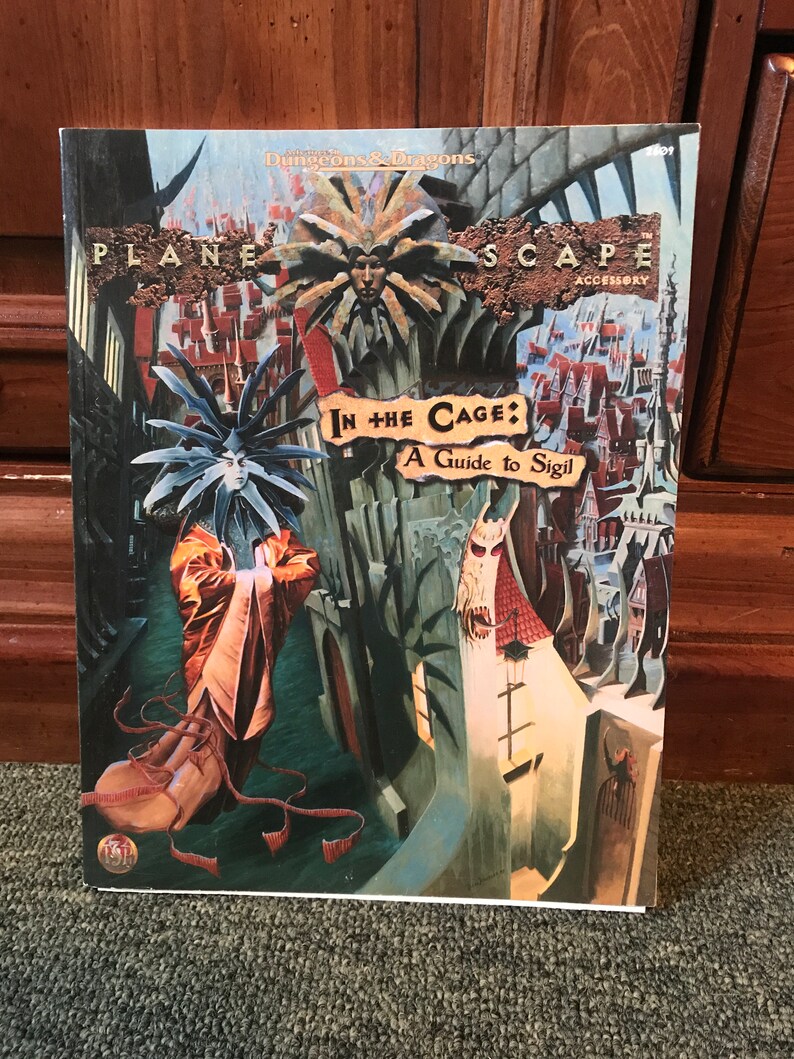
Something about the kind of corroded stone and the font choice really brings me back. There's a kind of aesthetic that probably had to do with the early capabilities of computer graphics that I think of as "sandstone and harsh light." Similarly, Planescape Torment has a contemporaneous and often compatible aesthetic that saw a lot of grimy, metallic structures (see also: Midgar from Final Fantasy VII) that were probably popular in part because the relatively simple reflective aspects of metal surfaces were easier to render in those early days of computer graphics.
Anyway, the Planescape setting is for D&D, but it is quite different from, say, the Forgotten Realms or Greyhawk in that it is not set in an earth-like world that happens to have a bunch of supernatural stuff on it, but instead puts the Outer Planes - the raw, inherently magical lands of fiends and celestials and other strange beings - as its primary setting.
Reading up on it, I found that it's considered by some to be D&D's take on the "New Weird," a broad artistic movement that seeks to replace genre cliches with new ideas, aesthetics, and tones. Planescape thus sets things far, far away from any kind of medieval castles. Things are, well, weird in Planescape's central location - the city of Sigil (which apparently is pronounced with a hard G, which infuriates me) - a ring-shaped city looking up on itself that holds portals to all the other planes and which is ruled over by the silent and enigmatic Lady of Pain - an omnipotent being who will annihilate anyone who tries to worship her as a god (that's her on the cover, both standing to the side and in statue form as part of the title.)
Anyway, "New Weird" seems to be a remarkably succinct term for my aeshetic style when it comes to fantasy. Mind you, I love Tolkien and the classic stuff, but I definitely like it when things get, well, weirder.
Actually, one of the odd things with D&D is that, following the Satanic Panic that singled out the game in particular in the 80s and early 90s, is that TSR (this was before Wizards of the Coast bought them) renamed Devils Baatorians (or I think Baatrezu) and Demons as Tanar'ri, to de-emphasize the parallels with real-world religious conceptions of, you know, evil spirits.
While there's certainly a part of me that feels this is silly - that surely people should be able to distinguish between fictional games and real spiritual truths (admittedly, as someone raised without any particular religion I never grew up thinking there were literal demons trying to corrupt me) - there's also a part of me that kind of likes this: that the audience does not simply get to rely on prior existing myths in order to contextualize what these beings are.
In large part, I think fantasy as a genre is about inventing mythology, but in a consciously fictional manner. Greek Myth, for example, was some of the foundational fantasy fiction of western literature, but the literality of it, or rather how literally people took it, is something that probably varied from culture to culture and epoch to epoch (not unlike modern religions. I certainly don't want to get too deep into this thorny subject, but existing sects of major religions today will disagree over whether stories from sacred texts are meant to be interpreted as historically accurate or allegorical tales of morality.)
But in this sense, I think that fantasy has the opportunity, yes, to rejigger and reinterpret classic mythological forms in new ways. Take A Song of Ice and Fire, for example, which presents very traditional fantasy elements - dragons and the undead - and then deconstructs the genre's nostalgic medievalism in presenting that type of society as fundamentally broken and, by today's standards, dystopian.
But fantasy also has license to create profoundly new types of myth. I don't know if there's any prior-existing mythology that has anything akin to the city of Sigil, but now that is created, it's a fantasy-myth we have the ability to interpret and play with.
I believe that there hasn't been any Planescape material published by Wizards since 3rd edition, but I'm now kind of obsessed with it. I think the next official setting sourcebook we're likely to get will be a hardcover version of the Wayfinder's Guide to Eberron, which to be fair, in its Dungeon Punk feel is also very 90s (despite the fact that it came out in the early 00s, I believe.)
But I'm very curious to see if they revisit this setting. 5th Edition has been really popular, and I think it's likely to last a while - if 2nd and 3rd editions both lasted about a decade each, perhaps we'll see 5th edition continuing on into 2025 or so, or even longer. I don't know what kind of products they have coming down the pipeline.
Interviews with Chris Perkins have suggested that they're hesitant to pump out too many books - they do want to focus on quality over quantity. But I will say that I'm far more excited for sourcebooks than published adventures.
I'd love to see a series of 5th edition sourcebooks for the various major settings. But given how freaking weird Planescape is, I'm now really hoping we get one for this setting.
While I'm very glad I got into it eventually, I've often felt some regret that I wasn't playing D&D as a kid, so suited as it is to my desire to tell stories and then get to experience those stories as games. Admittedly, I do sometimes wonder if I would engage with the game in a way I'd find interesting now as a guy in his early/mid 30s.
The point is:
I read an article on the A.V. Club about Planescape: Torment, a game that came out in the late 90s, somewhat of a set with games like Baldur's Gate, Icewind Dale, and the like. At the time, I was only just discovering JRPGs of the decade like Secret of Mana, and never actually played those titles.
But the thing is, looking at Planescape in particular, there seems to be an aesthetic that really brings me back to the 90s. I think the best way to demonstrate the aesthetic I'm talking about is just to show you:
Something about the kind of corroded stone and the font choice really brings me back. There's a kind of aesthetic that probably had to do with the early capabilities of computer graphics that I think of as "sandstone and harsh light." Similarly, Planescape Torment has a contemporaneous and often compatible aesthetic that saw a lot of grimy, metallic structures (see also: Midgar from Final Fantasy VII) that were probably popular in part because the relatively simple reflective aspects of metal surfaces were easier to render in those early days of computer graphics.
Anyway, the Planescape setting is for D&D, but it is quite different from, say, the Forgotten Realms or Greyhawk in that it is not set in an earth-like world that happens to have a bunch of supernatural stuff on it, but instead puts the Outer Planes - the raw, inherently magical lands of fiends and celestials and other strange beings - as its primary setting.
Reading up on it, I found that it's considered by some to be D&D's take on the "New Weird," a broad artistic movement that seeks to replace genre cliches with new ideas, aesthetics, and tones. Planescape thus sets things far, far away from any kind of medieval castles. Things are, well, weird in Planescape's central location - the city of Sigil (which apparently is pronounced with a hard G, which infuriates me) - a ring-shaped city looking up on itself that holds portals to all the other planes and which is ruled over by the silent and enigmatic Lady of Pain - an omnipotent being who will annihilate anyone who tries to worship her as a god (that's her on the cover, both standing to the side and in statue form as part of the title.)
Anyway, "New Weird" seems to be a remarkably succinct term for my aeshetic style when it comes to fantasy. Mind you, I love Tolkien and the classic stuff, but I definitely like it when things get, well, weirder.
Actually, one of the odd things with D&D is that, following the Satanic Panic that singled out the game in particular in the 80s and early 90s, is that TSR (this was before Wizards of the Coast bought them) renamed Devils Baatorians (or I think Baatrezu) and Demons as Tanar'ri, to de-emphasize the parallels with real-world religious conceptions of, you know, evil spirits.
While there's certainly a part of me that feels this is silly - that surely people should be able to distinguish between fictional games and real spiritual truths (admittedly, as someone raised without any particular religion I never grew up thinking there were literal demons trying to corrupt me) - there's also a part of me that kind of likes this: that the audience does not simply get to rely on prior existing myths in order to contextualize what these beings are.
In large part, I think fantasy as a genre is about inventing mythology, but in a consciously fictional manner. Greek Myth, for example, was some of the foundational fantasy fiction of western literature, but the literality of it, or rather how literally people took it, is something that probably varied from culture to culture and epoch to epoch (not unlike modern religions. I certainly don't want to get too deep into this thorny subject, but existing sects of major religions today will disagree over whether stories from sacred texts are meant to be interpreted as historically accurate or allegorical tales of morality.)
But in this sense, I think that fantasy has the opportunity, yes, to rejigger and reinterpret classic mythological forms in new ways. Take A Song of Ice and Fire, for example, which presents very traditional fantasy elements - dragons and the undead - and then deconstructs the genre's nostalgic medievalism in presenting that type of society as fundamentally broken and, by today's standards, dystopian.
But fantasy also has license to create profoundly new types of myth. I don't know if there's any prior-existing mythology that has anything akin to the city of Sigil, but now that is created, it's a fantasy-myth we have the ability to interpret and play with.
I believe that there hasn't been any Planescape material published by Wizards since 3rd edition, but I'm now kind of obsessed with it. I think the next official setting sourcebook we're likely to get will be a hardcover version of the Wayfinder's Guide to Eberron, which to be fair, in its Dungeon Punk feel is also very 90s (despite the fact that it came out in the early 00s, I believe.)
But I'm very curious to see if they revisit this setting. 5th Edition has been really popular, and I think it's likely to last a while - if 2nd and 3rd editions both lasted about a decade each, perhaps we'll see 5th edition continuing on into 2025 or so, or even longer. I don't know what kind of products they have coming down the pipeline.
Interviews with Chris Perkins have suggested that they're hesitant to pump out too many books - they do want to focus on quality over quantity. But I will say that I'm far more excited for sourcebooks than published adventures.
I'd love to see a series of 5th edition sourcebooks for the various major settings. But given how freaking weird Planescape is, I'm now really hoping we get one for this setting.
Friday, August 9, 2019
New Class, Fourth Spec, or Class Skins?
There's always a debate when it comes to whether WoW should, or even can, have a new class added in an upcoming expansion. Even when Demon Hunters came out, some argued that it was already too much (granted, as someone who had been hoping for Demon Hunters since Death Knights were introduced, I was very much on board.)
WoW has introduced a new class with every other expansion, meaning every four years given its two-year expansion cycle. The mechanics of how, exactly, they implement classes has gone back and forth - Death Knights were the first and, for eight years, only hero class with its unique starting experience and cosmetic features. Monks came in at level 1, which I actually think contributed to their being a far less popular class, given the level grind one needed to get through in order to play at max level. Demon Hunters were the most accommodated in terms of leveling - they started a mere two levels below the previous level cap, meaning one did not actually have to play through anything that wasn't Legion content to get them up to speed, allowing players to switch mains right at the start of the expansion with only about a two hour speed bump (Death Knights got high enough to go to Outland by the end of their starting experience, meaning they got to skip vanilla but they still needed to go through Burning Crusade before joining others in Wrath.)
So what is the benefit of a new class?
Well, new classes allow for new styles of gameplay. The Rune system is unlike any other class resource (and used to be far more complex.) Monks and Demon Hunters have introduced new forms of mobility.
But I think the primary advantage to new classes is flavor. The mechanics are a challenge for the developers, and while I think that this challenge forces them to come up with clever new ideas that can be fun, I do think the biggest boost to the game one gets with a new class is a new flavor - a new way to feel about the character you're playing.
I think this is why I've been so big a fan of the hero classes. Death Knights and Demon Hunters carry with them a specific story. After all, most classes are just a kind of job - one trains to be a Mage, or a Hunter, or a Paladin. It's not something that inherently changes you at a physiological level (at least not permanently - Druids and Shadow Priests can shift out of their transformations at will.) But the hero classes are individuals who have been changed at a fundamental level, which justifies both that they need a special story to explain what they are and also that they start at a higher power level than other classes - while I'd say that once you get to level 60 and are smacking around the likes of Ragnaros, levels beyond that are a purely mechanical feature of the game, your earlier levels are still very much telling a story of your character going from a novice and amateur to a skilled and experienced exemplar of your class. Because the training and imbued power for hero classes happens prior to your actual playing them, it makes sense that you'd start at a higher level.
But let's talk about the specific classes that have been added, and why.
Death Knights and Demon Hunters both play very important parts in the story of Warcraft. Death Knights, which admittedly are a more common fantasy trope (they exist in D&D and one could even make an argument that the Ringwraiths from Lord of the Rings are kind of DKs) were the class that kind of embodied the might of the Scourge. We didn't have a dark-magic melee class prior to them, but also with a character as iconic as Arthas, we needed a way for players to follow in his footsteps.
Monks, on the other hand, had not played a huge role in the game's lore. That beings said, Monks have also, over time, become a far more common RPG class. While Chen Stormstout was never as central a character to Warcraft as Arthas (or Illidan) was, his existence as a Brewmaster had led a lot of players to speculate and get excited about playing such a thing. The Monk was a pretty obvious option, especially for introducing the Pandaren and the China-themed Pandaria continent.
Demon Hunters were very much like Death Knights in that they had played a big role in the lore and also they had an exemplar in one of Warcraft's most iconic characters: Illidan Stormrage. Unlike Death Knights, however, there's no real precedent for them as a class in other RPGs - the Diablo III Demon Hunter, which is a bit more in the gothic witch-hunter vibe, is probably a more common trope. That being said, the Demon Hunter's kit was well-developed long before Legion came out, and players were very excited to play them.
So now we get to the first question I wanted to talk about:
With an even-numbered expansion almost certain to be announced at Blizzcon this year, should we expect a new class and, if so, what might it be?
Well, precedent would say that we must - every four years since 2007 we've gotten an expansion announcement that includes a new class. But precedent is not always consistent. After all, Mists of Pandaria gave us both a new class and a single new race, but then Warlords gave us neither. Admittedly, the introduction of Demon Hunters in Legion and then the many Allied Races in BFA would seem to have re-established the pattern of race-class-race-class.
But given that Allied Races have been a very different take on new races than what we've historically gotten, could that mean that we'll see a new take on "new classes?"
The thing about classes as compared to races is this:
Mechanically, race has a very low impact on the game. Your Void Elf Rogue is going to play almost identically to your Gnome Rogue. Yes, there are racial abilities that can have some impact, especially if you're a total min-maxer. I know that I'm hesitant to ever, say, start playing my Death Knight as my main instead of my Paladin given the human reputation buff that the Paladin gets. But you can be effective in any class your race can play, and it's about 98% a cosmetic choice (and 100% for most people.)
What this means is that it's much easier for Blizzard to add races than classes.
Allied Races, and the large number we've gotten, solved a problem: with all these alternate cultures and versions of existing races that players have wanted, it made total sense to make them playable. But if you have simply given us, say, Mag'har Orcs and Dark Iron Dwarves, the players would have been fairly justified in seeing it as a let-down given that they're still basically the same (in terms of animations and models) as existing races. But by giving us eight, rather than the usual two, it makes up for that.
Classes, however, are about 98% a choice in mechanics. To be fair, that might be an overestimate. I find playing a Demon Hunter way cooler than playing a Hunter, for example, in large part due to the story and flavor in the class. But mechanics are really the main thing in a class, and that means balancing and constant vigilance on the part of the developers.
Yes, occasionally a racial ability requires re-balancing, but for the most part, races are fire-and-forget in terms fo design. A class needs to be kept in line with all the new mechanics and standards of a new expansion or even major patch.
So it's a much bigger commitment.
Additionally, it's an area where there's not necessarily as much room for flavor. With races, you can pretty easily come up with something different. Take the Vulpera, for example, as a race many players are predicting will at some point become playable. Just pick an animal, make a humanoid version of it, and you've got a new race. Admittedly, previously established playable races that were animalistic were based on long-existing myths - Tauren are Minotaurs and Worgen are Werewolves - but between the Tuskarr, the Tortolloans, the Hozen, the Jinyu, the Grummles, the Arrakoa... it's pretty easy to slap together a reasonable humanoid animal race.
But with classes, you're dealing with more kind of archetypical forms.
I think it's noteworthy that in 5th Edition D&D, they don't actually add new classes (though this statement might date this post - it's possible the Artificer will come out with the hardcover version of Wayfinder's Guide to Eberron, and we did get a playtesting version of the Mystic a while back) but instead adds subclasses. In three published books - Sword Coast Adventurer's Guide, Xanathar's Guide to Everything, and Guildmaster's Guide to Ravnica - Wizards has added class options for its twelve playable classes - the D&D equivalent of Specializations - but not any new classes.
So that opens up an interesting notion: What if Blizzard were to, rather than add new classes, instead add new specs to the existing classes? Rather than add, say, Necromancers, maybe instead give Death Knights a ranged DPS spec?
Unfortunately, I don't think this is a likely option. And that's largely due to the way that class and spec design has changed since WoW began.
In Vanilla up until Mists, talents and spec were entwined notions. Rather than picking a spec at level 10 (and even that has changed - largely due to these changes, you now start with a particular spec) you would get access to your first talent point, and you'd begin assigning these points in one of three trees. The more invested you were in a particular tree, the more of an "X" spec character you were. This actually meant that before level 30 or so, a Paladin, for example, was actually pretty comparably capable at tanking, healing, or DPS regardless of where they'd put their talents.
The big thing is that this meant that specs shared a lot of abilities. Every Mage had Fireball, Frostbolt, and Arcane Missiles. The number of unique abilities a spec had access to was actually pretty low.
However, with the changes in Mists, where spec was not tied to these talent trees, Blizzard was able to cut out a ton of abilities that a given spec wasn't likely to use. Druids still have a broad suite of spells and abilities good for all their specs, but that's because Druids are supposed to be the versatile class. It used to be that every class's spellbook looked like that.
But this means that different specs have very little in terms of shared abilities. In other words, specs feel more like individual classes these days - rather than sharing abilities, it's the ease of switching back and forth that makes them feel unified.
In D&D, your class "specialization" (or sub-class) only brings new features every few levels (which is more significant in a game where the level cap is 20.) There are far more similarities between a Monster Slayer Ranger and a Gloomstalker Ranger than there are between a Survival Hunter and a Marksmanship Hunter.
And that's one big reason I think that it would be harder than it sounds to implement a "fourth spec" for each class in WoW. To put it simply, it would require developing 12 new specs (maybe 11 given that Druids already have four) while a new class would be only 3, or even 2, as Demon Hunters proved.
But what of class skins?
Allied Races, with the exception of Kul Tirans and Zandalari, simply use existing models and tweak them a bit. Void Elves are just blue and be-tentacled (sometimes) Blood Elves. Lightforged Draenei are grey Draenei with golden eyes and cooler horns and beards.
So what if we were to do something like an allied race for classes? Take existing classes and change the look and flavor of their abilities, but keep the mechanics?
To be fair, I think this could work. I've always kind of chased the notion of a Battlemage - someone who wears heavy armor and fights in close quarters but also wields arcane magic - in many RPGs (I play an Eldritch Knight in an ongoing D&D campaign, which I think pretty much describes that.) Allowing my Paladin to re-skin his class as some kind of Arcane Knight could give you that without forcing Blizzard to come up with a whole redesign (to be fair, Death Knight might be a better class to re-skin, as Arcane magic tends not to do much healing.)
The downside, which is also an upside for hardworking developers, is that there would be no new mechanics here. You'd need to come up with new animations and new names for abilities, but you could keep everything under the hood working the same way.
I don't think it's problem-free, though.
The biggest issue I imagine is that some classes would be far easier to skin than others. Swap out demons and fel magic for undead and necromancy? You can easily imagine a Warlock as a Necromancer. As I said before, a Paladin or Death Knight could easily be flavored as a Battlemage.
But other classes, especially those less magic-based ones, could pose a serious challenge. Take Rogues, for example. How would you re-skin rogues? Especially given that its specs already kind of cover different flavors of Rogue. Outlaw Rogues are already Pirates (and also kind of 18th Century Highwaymen, though that seems to be a less popular archetype) and Subtlety is already the kind of mystic Ninja spec. So where even could you go with a class that dual-wields, usually daggers, and sneaks around a lot?
Indeed, I actually think a fourth spec for Rogues is more obvious than a class skin - namely a ranged DPS spec that uses bows and such.
And even if classes are feeling crowded, would class skins be closing more doors than it was opening? Take Necromancers, for example. Yes, there's a ton of overlap with both Warlocks and Death Knights in terms of flavor and likely mechanics. But wouldn't it also be cool to have a dark-magic-themed healing class? I'd love to see Necromancers as a hybrid ranged-caster and healer. And if you were just to use it as a skin on Warlocks, you wouldn't be able to do the latter half of that.
I think we'll be due for some big thing class-wise in this year's Blizzcon announcement. But what it actually will be remains a mystery. Ironically, at this point in the post, simply adding a new class actually looks like the simplest option. And I certainly wouldn't complain.
WoW has introduced a new class with every other expansion, meaning every four years given its two-year expansion cycle. The mechanics of how, exactly, they implement classes has gone back and forth - Death Knights were the first and, for eight years, only hero class with its unique starting experience and cosmetic features. Monks came in at level 1, which I actually think contributed to their being a far less popular class, given the level grind one needed to get through in order to play at max level. Demon Hunters were the most accommodated in terms of leveling - they started a mere two levels below the previous level cap, meaning one did not actually have to play through anything that wasn't Legion content to get them up to speed, allowing players to switch mains right at the start of the expansion with only about a two hour speed bump (Death Knights got high enough to go to Outland by the end of their starting experience, meaning they got to skip vanilla but they still needed to go through Burning Crusade before joining others in Wrath.)
So what is the benefit of a new class?
Well, new classes allow for new styles of gameplay. The Rune system is unlike any other class resource (and used to be far more complex.) Monks and Demon Hunters have introduced new forms of mobility.
But I think the primary advantage to new classes is flavor. The mechanics are a challenge for the developers, and while I think that this challenge forces them to come up with clever new ideas that can be fun, I do think the biggest boost to the game one gets with a new class is a new flavor - a new way to feel about the character you're playing.
I think this is why I've been so big a fan of the hero classes. Death Knights and Demon Hunters carry with them a specific story. After all, most classes are just a kind of job - one trains to be a Mage, or a Hunter, or a Paladin. It's not something that inherently changes you at a physiological level (at least not permanently - Druids and Shadow Priests can shift out of their transformations at will.) But the hero classes are individuals who have been changed at a fundamental level, which justifies both that they need a special story to explain what they are and also that they start at a higher power level than other classes - while I'd say that once you get to level 60 and are smacking around the likes of Ragnaros, levels beyond that are a purely mechanical feature of the game, your earlier levels are still very much telling a story of your character going from a novice and amateur to a skilled and experienced exemplar of your class. Because the training and imbued power for hero classes happens prior to your actual playing them, it makes sense that you'd start at a higher level.
But let's talk about the specific classes that have been added, and why.
Death Knights and Demon Hunters both play very important parts in the story of Warcraft. Death Knights, which admittedly are a more common fantasy trope (they exist in D&D and one could even make an argument that the Ringwraiths from Lord of the Rings are kind of DKs) were the class that kind of embodied the might of the Scourge. We didn't have a dark-magic melee class prior to them, but also with a character as iconic as Arthas, we needed a way for players to follow in his footsteps.
Monks, on the other hand, had not played a huge role in the game's lore. That beings said, Monks have also, over time, become a far more common RPG class. While Chen Stormstout was never as central a character to Warcraft as Arthas (or Illidan) was, his existence as a Brewmaster had led a lot of players to speculate and get excited about playing such a thing. The Monk was a pretty obvious option, especially for introducing the Pandaren and the China-themed Pandaria continent.
Demon Hunters were very much like Death Knights in that they had played a big role in the lore and also they had an exemplar in one of Warcraft's most iconic characters: Illidan Stormrage. Unlike Death Knights, however, there's no real precedent for them as a class in other RPGs - the Diablo III Demon Hunter, which is a bit more in the gothic witch-hunter vibe, is probably a more common trope. That being said, the Demon Hunter's kit was well-developed long before Legion came out, and players were very excited to play them.
So now we get to the first question I wanted to talk about:
With an even-numbered expansion almost certain to be announced at Blizzcon this year, should we expect a new class and, if so, what might it be?
Well, precedent would say that we must - every four years since 2007 we've gotten an expansion announcement that includes a new class. But precedent is not always consistent. After all, Mists of Pandaria gave us both a new class and a single new race, but then Warlords gave us neither. Admittedly, the introduction of Demon Hunters in Legion and then the many Allied Races in BFA would seem to have re-established the pattern of race-class-race-class.
But given that Allied Races have been a very different take on new races than what we've historically gotten, could that mean that we'll see a new take on "new classes?"
The thing about classes as compared to races is this:
Mechanically, race has a very low impact on the game. Your Void Elf Rogue is going to play almost identically to your Gnome Rogue. Yes, there are racial abilities that can have some impact, especially if you're a total min-maxer. I know that I'm hesitant to ever, say, start playing my Death Knight as my main instead of my Paladin given the human reputation buff that the Paladin gets. But you can be effective in any class your race can play, and it's about 98% a cosmetic choice (and 100% for most people.)
What this means is that it's much easier for Blizzard to add races than classes.
Allied Races, and the large number we've gotten, solved a problem: with all these alternate cultures and versions of existing races that players have wanted, it made total sense to make them playable. But if you have simply given us, say, Mag'har Orcs and Dark Iron Dwarves, the players would have been fairly justified in seeing it as a let-down given that they're still basically the same (in terms of animations and models) as existing races. But by giving us eight, rather than the usual two, it makes up for that.
Classes, however, are about 98% a choice in mechanics. To be fair, that might be an overestimate. I find playing a Demon Hunter way cooler than playing a Hunter, for example, in large part due to the story and flavor in the class. But mechanics are really the main thing in a class, and that means balancing and constant vigilance on the part of the developers.
Yes, occasionally a racial ability requires re-balancing, but for the most part, races are fire-and-forget in terms fo design. A class needs to be kept in line with all the new mechanics and standards of a new expansion or even major patch.
So it's a much bigger commitment.
Additionally, it's an area where there's not necessarily as much room for flavor. With races, you can pretty easily come up with something different. Take the Vulpera, for example, as a race many players are predicting will at some point become playable. Just pick an animal, make a humanoid version of it, and you've got a new race. Admittedly, previously established playable races that were animalistic were based on long-existing myths - Tauren are Minotaurs and Worgen are Werewolves - but between the Tuskarr, the Tortolloans, the Hozen, the Jinyu, the Grummles, the Arrakoa... it's pretty easy to slap together a reasonable humanoid animal race.
But with classes, you're dealing with more kind of archetypical forms.
I think it's noteworthy that in 5th Edition D&D, they don't actually add new classes (though this statement might date this post - it's possible the Artificer will come out with the hardcover version of Wayfinder's Guide to Eberron, and we did get a playtesting version of the Mystic a while back) but instead adds subclasses. In three published books - Sword Coast Adventurer's Guide, Xanathar's Guide to Everything, and Guildmaster's Guide to Ravnica - Wizards has added class options for its twelve playable classes - the D&D equivalent of Specializations - but not any new classes.
So that opens up an interesting notion: What if Blizzard were to, rather than add new classes, instead add new specs to the existing classes? Rather than add, say, Necromancers, maybe instead give Death Knights a ranged DPS spec?
Unfortunately, I don't think this is a likely option. And that's largely due to the way that class and spec design has changed since WoW began.
In Vanilla up until Mists, talents and spec were entwined notions. Rather than picking a spec at level 10 (and even that has changed - largely due to these changes, you now start with a particular spec) you would get access to your first talent point, and you'd begin assigning these points in one of three trees. The more invested you were in a particular tree, the more of an "X" spec character you were. This actually meant that before level 30 or so, a Paladin, for example, was actually pretty comparably capable at tanking, healing, or DPS regardless of where they'd put their talents.
The big thing is that this meant that specs shared a lot of abilities. Every Mage had Fireball, Frostbolt, and Arcane Missiles. The number of unique abilities a spec had access to was actually pretty low.
However, with the changes in Mists, where spec was not tied to these talent trees, Blizzard was able to cut out a ton of abilities that a given spec wasn't likely to use. Druids still have a broad suite of spells and abilities good for all their specs, but that's because Druids are supposed to be the versatile class. It used to be that every class's spellbook looked like that.
But this means that different specs have very little in terms of shared abilities. In other words, specs feel more like individual classes these days - rather than sharing abilities, it's the ease of switching back and forth that makes them feel unified.
In D&D, your class "specialization" (or sub-class) only brings new features every few levels (which is more significant in a game where the level cap is 20.) There are far more similarities between a Monster Slayer Ranger and a Gloomstalker Ranger than there are between a Survival Hunter and a Marksmanship Hunter.
And that's one big reason I think that it would be harder than it sounds to implement a "fourth spec" for each class in WoW. To put it simply, it would require developing 12 new specs (maybe 11 given that Druids already have four) while a new class would be only 3, or even 2, as Demon Hunters proved.
But what of class skins?
Allied Races, with the exception of Kul Tirans and Zandalari, simply use existing models and tweak them a bit. Void Elves are just blue and be-tentacled (sometimes) Blood Elves. Lightforged Draenei are grey Draenei with golden eyes and cooler horns and beards.
So what if we were to do something like an allied race for classes? Take existing classes and change the look and flavor of their abilities, but keep the mechanics?
To be fair, I think this could work. I've always kind of chased the notion of a Battlemage - someone who wears heavy armor and fights in close quarters but also wields arcane magic - in many RPGs (I play an Eldritch Knight in an ongoing D&D campaign, which I think pretty much describes that.) Allowing my Paladin to re-skin his class as some kind of Arcane Knight could give you that without forcing Blizzard to come up with a whole redesign (to be fair, Death Knight might be a better class to re-skin, as Arcane magic tends not to do much healing.)
The downside, which is also an upside for hardworking developers, is that there would be no new mechanics here. You'd need to come up with new animations and new names for abilities, but you could keep everything under the hood working the same way.
I don't think it's problem-free, though.
The biggest issue I imagine is that some classes would be far easier to skin than others. Swap out demons and fel magic for undead and necromancy? You can easily imagine a Warlock as a Necromancer. As I said before, a Paladin or Death Knight could easily be flavored as a Battlemage.
But other classes, especially those less magic-based ones, could pose a serious challenge. Take Rogues, for example. How would you re-skin rogues? Especially given that its specs already kind of cover different flavors of Rogue. Outlaw Rogues are already Pirates (and also kind of 18th Century Highwaymen, though that seems to be a less popular archetype) and Subtlety is already the kind of mystic Ninja spec. So where even could you go with a class that dual-wields, usually daggers, and sneaks around a lot?
Indeed, I actually think a fourth spec for Rogues is more obvious than a class skin - namely a ranged DPS spec that uses bows and such.
And even if classes are feeling crowded, would class skins be closing more doors than it was opening? Take Necromancers, for example. Yes, there's a ton of overlap with both Warlocks and Death Knights in terms of flavor and likely mechanics. But wouldn't it also be cool to have a dark-magic-themed healing class? I'd love to see Necromancers as a hybrid ranged-caster and healer. And if you were just to use it as a skin on Warlocks, you wouldn't be able to do the latter half of that.
I think we'll be due for some big thing class-wise in this year's Blizzcon announcement. But what it actually will be remains a mystery. Ironically, at this point in the post, simply adding a new class actually looks like the simplest option. And I certainly wouldn't complain.
Sunday, August 4, 2019
I Have So Many D&D (And Other TTRPG) Games I Want to Run
My original D&D campaign is now in its fourth year, though scheduling conflicts, among other things, have made it far less of a weekly thing.
I do play in a (more regular) weekly D&D campaign, as well as weekly Adventurer's League games (often run by the friend who runs that campaign.)
I created a group in order to run one-shot games, the idea being that I could set a date and then build the adventure around whoever was able to come, of which I've run two (actually the same adventure with different players) but I do have such grand ambitions.
So, right now: my main campaign is an ongoing epic, with characters gradually uncovering dangers that will, over time, relate more and more to their own backstories.
I have two major D&D campaign concepts that I want to run.
One is set within the same world (my homebrew world of Sarkon) and would be set after the events of the first campaign. In fact, there's a particular move that I want the players to make that will set up the events of that campaign. While the current one is very Cosmic-Horror themed, the next would, ideally, be more of a Lord of the Rings-style epic war campaign in which the... um, spoilers if you're in my D&D group... Angel of Death is released from his 60,000 year imprisonment and raises and army of the dead to kill everyone (he'd probably have reskinned stats for Orcus, changing his creature type from Demon to either Celestial or Undead and alignment from Chaotic Evil to Lawful Evil - maybe futzing with a few under-the-hood things as well.)
The other campaign would be a Ravnica campaign. While I did do a one-shot (which has a second chapter if we ever want to make it a two-shot) for level 18 characters, I'd really like to also run a game starting at low levels (probably 2 or 3) and have the players work their way up. My concept here would borrow a lot from Magic lore, perhaps bending a few rules. Basically, it would start with Squee, the immortal goblin, finding himself on Ravnica and the guilds fighting over control of him. We'd have some guild-based villains to reckon with but then probably have the Phyrexians as the big bads, because I am old-school.
Then, on top of that, I'd like to run a Call of Cthulhu game - right now with the Starter Set I think it's really geared around running the pre-fab adventures, but if we decide we like it I'll probably get the actual books and try to build a game set within my own Massachusetts hometown, because even if it was a super-safe suburb, when you're a little kid you populate the spaces you inhabit with all manner of terrifying monsters. I'd like to share them!
Oh, and back to D&D!
My longterm ambition is to one day do a Chrono Trigger-style time-travel campaign. My homebrew world has a lot of different eras that we could use, and even though that would probably be incredibly freaking difficult to pull off, I fucking want to.
Oh, and also I kind of want to homebrew all the WoW races (and maybe classes...?) for D&D 5e and run a campaign set in Azeroth (though that would probably be more of a one-shot deal.)
The problem, however, is that getting a group of adults in their 20s and 30s to come together regularly to play D&D, especially when most of them work in the performing arts and have wildly irregular schedules, is a pain. in. the. ass. But that's my friends!
If I manage to check each of these off my list at some point, I'll be very happy.
I do play in a (more regular) weekly D&D campaign, as well as weekly Adventurer's League games (often run by the friend who runs that campaign.)
I created a group in order to run one-shot games, the idea being that I could set a date and then build the adventure around whoever was able to come, of which I've run two (actually the same adventure with different players) but I do have such grand ambitions.
So, right now: my main campaign is an ongoing epic, with characters gradually uncovering dangers that will, over time, relate more and more to their own backstories.
I have two major D&D campaign concepts that I want to run.
One is set within the same world (my homebrew world of Sarkon) and would be set after the events of the first campaign. In fact, there's a particular move that I want the players to make that will set up the events of that campaign. While the current one is very Cosmic-Horror themed, the next would, ideally, be more of a Lord of the Rings-style epic war campaign in which the... um, spoilers if you're in my D&D group... Angel of Death is released from his 60,000 year imprisonment and raises and army of the dead to kill everyone (he'd probably have reskinned stats for Orcus, changing his creature type from Demon to either Celestial or Undead and alignment from Chaotic Evil to Lawful Evil - maybe futzing with a few under-the-hood things as well.)
The other campaign would be a Ravnica campaign. While I did do a one-shot (which has a second chapter if we ever want to make it a two-shot) for level 18 characters, I'd really like to also run a game starting at low levels (probably 2 or 3) and have the players work their way up. My concept here would borrow a lot from Magic lore, perhaps bending a few rules. Basically, it would start with Squee, the immortal goblin, finding himself on Ravnica and the guilds fighting over control of him. We'd have some guild-based villains to reckon with but then probably have the Phyrexians as the big bads, because I am old-school.
Then, on top of that, I'd like to run a Call of Cthulhu game - right now with the Starter Set I think it's really geared around running the pre-fab adventures, but if we decide we like it I'll probably get the actual books and try to build a game set within my own Massachusetts hometown, because even if it was a super-safe suburb, when you're a little kid you populate the spaces you inhabit with all manner of terrifying monsters. I'd like to share them!
Oh, and back to D&D!
My longterm ambition is to one day do a Chrono Trigger-style time-travel campaign. My homebrew world has a lot of different eras that we could use, and even though that would probably be incredibly freaking difficult to pull off, I fucking want to.
Oh, and also I kind of want to homebrew all the WoW races (and maybe classes...?) for D&D 5e and run a campaign set in Azeroth (though that would probably be more of a one-shot deal.)
The problem, however, is that getting a group of adults in their 20s and 30s to come together regularly to play D&D, especially when most of them work in the performing arts and have wildly irregular schedules, is a pain. in. the. ass. But that's my friends!
If I manage to check each of these off my list at some point, I'll be very happy.
Friday, August 2, 2019
Call of Cthulhu
I've chosen a TTRPG to branch out into. And while I'm sure it would be interesting to see heroic fantasy from a Pathfinder perspective (one of my friends says she likes it better than 5E, and she and I are both eager DMs, running ongoing campaigns with one another in them, so maybe I can convince her to run a Pathfinder one-shot or something) I've always been intrigued by Call of Cthulhu.
I think Cosmic Horror was one of those things influencing me long before I knew it for what it was. Twin Peaks, for example, was something I didn't actually watch when it was on the air (I was almost 4 when it premiered) but its effect on 90s pop culture was definitely strong. And Stephen King, whose horror is more grounded than Lovecraft's but still definitely plays with ideas of otherworldly, incomprehensible threats, got his hooks into me my senior year of high school with the Dark Tower series.
My fiction errs on the side of humanist optimism (Star Trek was also a big influence on me) but I definitely go to the well of Cosmic Horror for antagonistic forces.
So running a game based on Lovecraft sounds pretty cool. I have a lot of Cosmic Horror elements in my homebrew D&D setting, but player characters in that game are naturally quite powerful (though I haven't hit them with Star Spawn yet. Thankfully the Paladin just got high enough level to cast Revivify, so I might feel less guilty about taking the gloves off now!)
Here's the other element:
I grew up in New England.
So, the Cosmic Horror genre clearly extends beyond Lovecraft himself, and old Howard Philip has a problematic legacy. While he conceived of some of the most iconic elements of the genre - there's a reason we often call it "Lovecraftian Horror" - the man was also considered racist even for the 1920s.
And indeed, it colors some of the ideas he was working with in his fiction. Most basically, his assumption that the "other" and "alien" was inherently monstrous applied not only to be-tentacled creatures from beyond the stars, but also to, you know, people who didn't look like him. This manifests in a pervasive theme in a lot of his writing that people of other cultures are seen as evil, sometimes implying that they are corrupted with taint from these alien beings.
The notion that the same kind of existential, "pulling the rug from under you" horror from witnessing these cosmic entities at work could also come from a racist merely contemplating, say, having nonwhite ancestry, deflates a lot of the fun to be had by walking up to that scariness in a safe, fictional manner.
So from the beginning, there's a certain question of how we can explore the quite real and potent fears of humanity's tininess in a universe we only barely understand without employing outdated and hateful tropes. I think that we can, but it does take mindfulness.
Bearing that in mind, the fact that Lovecraft was a New Englander means that the areas he was talking about are, actually, very familiar territory to me. I grew up in a suburb of Boston, and so Eastern Mass. is home to me.
Likewise, I was a scared little boy growing up. I didn't have a traumatic childhood or anything - far from it - but I had an active imagination and I grew up in a creaky old Victorian house.
In my childhood, I populated most of the rooms of that house, as well as the surrounding neighborhood, with all manner of monsters. I knew which walls would stretch out with ghastly figures to grab you, why you should never use the bathroom with the shower curtain drawn, and that one tree you had to be sure to look at only an even number of times. (Incidentally, Stephen King's novella "N" really worked for me.)
Given that Lovecraft's Arkham is meant to be the fictional equivalent of Salem (infamous of course for its witch trials, though it was also a major port that briefly rivaled Boston) it occurred to me:
If you're going to run a Call of Cthulhu game, why make up a fictional setting? Why not use the city you know better than any other?
Therefore, I'm intending to run a Call of Cthulhu game set in my own hometown, probably using my own childhood home as a major location for it.
Bonus points: one of my best friends out here in LA is someone I've known since high school, and he actually went to the same elementary school (he's a year older, which is why I didn't know him until later.) I went so far as to actually look up an old 1920s zoning map of our hometown and found that, where his childhood home is, there was undeveloped land with a little stream running through it.
Given that he'll almost certainly be playing in the game, I'm for sure going to have some monstrous thing precisely where his house would later be built.
I am, of course, not yet totally familiar with the rules of the game or how to build adventures as the Keeper of Arcane Lore (the game's equivalent of DM) but I really hope I can pull this off.
I think Cosmic Horror was one of those things influencing me long before I knew it for what it was. Twin Peaks, for example, was something I didn't actually watch when it was on the air (I was almost 4 when it premiered) but its effect on 90s pop culture was definitely strong. And Stephen King, whose horror is more grounded than Lovecraft's but still definitely plays with ideas of otherworldly, incomprehensible threats, got his hooks into me my senior year of high school with the Dark Tower series.
My fiction errs on the side of humanist optimism (Star Trek was also a big influence on me) but I definitely go to the well of Cosmic Horror for antagonistic forces.
So running a game based on Lovecraft sounds pretty cool. I have a lot of Cosmic Horror elements in my homebrew D&D setting, but player characters in that game are naturally quite powerful (though I haven't hit them with Star Spawn yet. Thankfully the Paladin just got high enough level to cast Revivify, so I might feel less guilty about taking the gloves off now!)
Here's the other element:
I grew up in New England.
So, the Cosmic Horror genre clearly extends beyond Lovecraft himself, and old Howard Philip has a problematic legacy. While he conceived of some of the most iconic elements of the genre - there's a reason we often call it "Lovecraftian Horror" - the man was also considered racist even for the 1920s.
And indeed, it colors some of the ideas he was working with in his fiction. Most basically, his assumption that the "other" and "alien" was inherently monstrous applied not only to be-tentacled creatures from beyond the stars, but also to, you know, people who didn't look like him. This manifests in a pervasive theme in a lot of his writing that people of other cultures are seen as evil, sometimes implying that they are corrupted with taint from these alien beings.
The notion that the same kind of existential, "pulling the rug from under you" horror from witnessing these cosmic entities at work could also come from a racist merely contemplating, say, having nonwhite ancestry, deflates a lot of the fun to be had by walking up to that scariness in a safe, fictional manner.
So from the beginning, there's a certain question of how we can explore the quite real and potent fears of humanity's tininess in a universe we only barely understand without employing outdated and hateful tropes. I think that we can, but it does take mindfulness.
Bearing that in mind, the fact that Lovecraft was a New Englander means that the areas he was talking about are, actually, very familiar territory to me. I grew up in a suburb of Boston, and so Eastern Mass. is home to me.
Likewise, I was a scared little boy growing up. I didn't have a traumatic childhood or anything - far from it - but I had an active imagination and I grew up in a creaky old Victorian house.
In my childhood, I populated most of the rooms of that house, as well as the surrounding neighborhood, with all manner of monsters. I knew which walls would stretch out with ghastly figures to grab you, why you should never use the bathroom with the shower curtain drawn, and that one tree you had to be sure to look at only an even number of times. (Incidentally, Stephen King's novella "N" really worked for me.)
Given that Lovecraft's Arkham is meant to be the fictional equivalent of Salem (infamous of course for its witch trials, though it was also a major port that briefly rivaled Boston) it occurred to me:
If you're going to run a Call of Cthulhu game, why make up a fictional setting? Why not use the city you know better than any other?
Therefore, I'm intending to run a Call of Cthulhu game set in my own hometown, probably using my own childhood home as a major location for it.
Bonus points: one of my best friends out here in LA is someone I've known since high school, and he actually went to the same elementary school (he's a year older, which is why I didn't know him until later.) I went so far as to actually look up an old 1920s zoning map of our hometown and found that, where his childhood home is, there was undeveloped land with a little stream running through it.
Given that he'll almost certainly be playing in the game, I'm for sure going to have some monstrous thing precisely where his house would later be built.
I am, of course, not yet totally familiar with the rules of the game or how to build adventures as the Keeper of Arcane Lore (the game's equivalent of DM) but I really hope I can pull this off.
The Fate of Azshara
Spoilers for the end of the Eternal Palace Raid (though I guess the title is almost a spoiler itself... so sorry.)
When we fight our way (well, when heroes do - I must confess I haven't run Eternal Palace at all, and never did most of Battle for Dazar'alor...) up to Azshara and defeat her at the end of the current raid, her end is much more of an ellipsis than a period.
Whether she truly dies or not, upon defeat she collapses while her mission - unlocking N'zoth's prison - is a success. When the Old God's shadowy essence blasts its way out of the deep abyss below, it gathers Azshara and her eyes shoot open in a look of...
What is that? Terror? Shock?
Here's my take:
Azshara has convinced herself since first making the deal with N'zoth that she was getting the better end of the deal. Her ego is the largest in the entire Warcraft cosmos, such that she literally defined her society's hierarchy over who fawned over her the most. Yes, the physiological differences between the Night Elves and Blood Elves are actually the (somewhat indirect) result over whose ancestors sucked up more to Azshara.
Given that N'zoth is far older than Azshara's entire race (and I'm not even just talking about the Naga,) and that over that time he succeeded primarily by manipulating things behind the scenes, Azshara was probably an easy mark for his games. Again, my read on the Azshara Warbringers short is that the sly, scheming voice at the beginning is much closer to N'zoth's actual personality than the bellowing rage-god. (Though I'd have kind of loved it if they'd gone with a third option and had him sound like a totally reasonable and even concerned and caring voice in that moment - but that would undercut the point I'm about to make.) Letting Azshara think she had out-maneuvered him was all part of the pitch.
Given that take on Warbringers, my read on the expression on Azshara's face when N'zoth grabs her, possibly reviving her, is one of abject terror.
Now, what is the source of that terror?
Is it Azshara realizing that all this time she's been the pawn? That her inflated sense of importance is actually a lie? That she's second fiddle to literally anyone else?
Or perhaps, like Arthas as he drifted off into his nothingness of an afterlife, she had truly been dead and now saw that there was no grand rebirth, no glory for her. That she was, in the end, just a mortal?
Or there's a third possibility.
Azshara's actual endgame in her two biggest "betray the planet" schemes were always a little muddy. When she tried to bring Sargeras to Azeroth, she theoretically wanted Sargeras as her husband - the only being great enough to be worthy of her. And to be certain, Azshara was powerful - thought to be comparable to if not exceeding the power of Archimonde or Kil'jaeden (though that was never tested.) But one imagines that, had Sargeras' plans come to fruition, we'd have one of two scenarios. Either Sargeras would have made Azeroth another Fel Titan, in which case he'd probably have dropped any false interest in Azshara, perhaps deigning to let her become a powerful demon, or if Azeroth had been destroyed, he might have just killed Azshara in the process.
Because as powerful as Azshara was, I think the general consensus is that the only single entity more powerful than Sargeras is an Azeroth that makes it to adulthood. (Though get back to me if we ever figure out what the hell Elune is.)
Azshara might have hoped to rule a reborn Black Empire, but one really wonders if that was ever in the cards. Being Queen is still a secondary position when you've got a God right there.
But the point that I'm taking a long time to get to here is that Azshara understands arcane magic intrinsically (in D&D she'd definitely be a Sorcerer,) but the true, cosmic horror of what the Void represents is probably not something she's ever thought to reckon with. N'zoth is a means to an end, the end being the restoration to her proper place as Empress of the World.
And the Void has changed her, mutating her into this five-eyed aquatic monstrosity, but she still sees only her own beauty.
What if death forced her to see the Void for what it really is?
What if she has only just now realized the horrors her ego has bought her?
And for most of us, sure we've got the Curse of Flesh, and we're vulnerable to the Old Gods' corruption. But she has been stewing in it for ten thousand years. There is no hope whatsoever for her. And the ends the Old Gods are striving for?
The Black Empire was only ever a means, not an end. The Old Gods themselves are only a means, not an end. Even the Void Titan that they seek to make of Azeroth is only a means, and not an end.
The end is darkness everywhere - a universe of only Void. No empire. No subjects. No beauty. No power.
No Azshara.
And for ten thousand years, she has been working toward that end.
And perhaps in that moment, she realized it.
So what does she do now?
She is so deeply corrupted that it's not even clear she'll be able to exercise her free will. Sure, she's been given the illusion of agency for all the time that she was doing exactly what N'zoth wanted. But if you look at how batshit the Old Gods (and it's implied, specifically N'zoth) made Neltharion, to the point where his entire dragonflight is bombarded by whispers of the Void (even Ebonhorn, a theoretically cleansed Black Dragon, has to fight off those whispers - maybe it wasn't the best idea to live so close to where Dad went crazy for ten thousand years, Ebyssian?) you have got to imagine that N'zoth's installed a bunch of back doors to Azshara's programming to control everything she does.
So Azshara is screwed. Even if she realizes what she's done. But is it possible that she could do something - anything - to prevent the dark fate that she has contributed to? Might some glimmer of the real Azshara - not benevolent, not altruistic, but defiant - show through?
Or, if she realizes how screwed she is, will she find no reason to care? After all, is she is lost, then the whole world is lost, if she is the whole world.
Blizzard chose not to kill, or at least not permanently kill, Azshara for a reason. It may be a long time before we find out why, but it's a really interesting choice.
When we fight our way (well, when heroes do - I must confess I haven't run Eternal Palace at all, and never did most of Battle for Dazar'alor...) up to Azshara and defeat her at the end of the current raid, her end is much more of an ellipsis than a period.
Whether she truly dies or not, upon defeat she collapses while her mission - unlocking N'zoth's prison - is a success. When the Old God's shadowy essence blasts its way out of the deep abyss below, it gathers Azshara and her eyes shoot open in a look of...
What is that? Terror? Shock?
Here's my take:
Azshara has convinced herself since first making the deal with N'zoth that she was getting the better end of the deal. Her ego is the largest in the entire Warcraft cosmos, such that she literally defined her society's hierarchy over who fawned over her the most. Yes, the physiological differences between the Night Elves and Blood Elves are actually the (somewhat indirect) result over whose ancestors sucked up more to Azshara.
Given that N'zoth is far older than Azshara's entire race (and I'm not even just talking about the Naga,) and that over that time he succeeded primarily by manipulating things behind the scenes, Azshara was probably an easy mark for his games. Again, my read on the Azshara Warbringers short is that the sly, scheming voice at the beginning is much closer to N'zoth's actual personality than the bellowing rage-god. (Though I'd have kind of loved it if they'd gone with a third option and had him sound like a totally reasonable and even concerned and caring voice in that moment - but that would undercut the point I'm about to make.) Letting Azshara think she had out-maneuvered him was all part of the pitch.
Given that take on Warbringers, my read on the expression on Azshara's face when N'zoth grabs her, possibly reviving her, is one of abject terror.
Now, what is the source of that terror?
Is it Azshara realizing that all this time she's been the pawn? That her inflated sense of importance is actually a lie? That she's second fiddle to literally anyone else?
Or perhaps, like Arthas as he drifted off into his nothingness of an afterlife, she had truly been dead and now saw that there was no grand rebirth, no glory for her. That she was, in the end, just a mortal?
Or there's a third possibility.
Azshara's actual endgame in her two biggest "betray the planet" schemes were always a little muddy. When she tried to bring Sargeras to Azeroth, she theoretically wanted Sargeras as her husband - the only being great enough to be worthy of her. And to be certain, Azshara was powerful - thought to be comparable to if not exceeding the power of Archimonde or Kil'jaeden (though that was never tested.) But one imagines that, had Sargeras' plans come to fruition, we'd have one of two scenarios. Either Sargeras would have made Azeroth another Fel Titan, in which case he'd probably have dropped any false interest in Azshara, perhaps deigning to let her become a powerful demon, or if Azeroth had been destroyed, he might have just killed Azshara in the process.
Because as powerful as Azshara was, I think the general consensus is that the only single entity more powerful than Sargeras is an Azeroth that makes it to adulthood. (Though get back to me if we ever figure out what the hell Elune is.)
Azshara might have hoped to rule a reborn Black Empire, but one really wonders if that was ever in the cards. Being Queen is still a secondary position when you've got a God right there.
But the point that I'm taking a long time to get to here is that Azshara understands arcane magic intrinsically (in D&D she'd definitely be a Sorcerer,) but the true, cosmic horror of what the Void represents is probably not something she's ever thought to reckon with. N'zoth is a means to an end, the end being the restoration to her proper place as Empress of the World.
And the Void has changed her, mutating her into this five-eyed aquatic monstrosity, but she still sees only her own beauty.
What if death forced her to see the Void for what it really is?
What if she has only just now realized the horrors her ego has bought her?
And for most of us, sure we've got the Curse of Flesh, and we're vulnerable to the Old Gods' corruption. But she has been stewing in it for ten thousand years. There is no hope whatsoever for her. And the ends the Old Gods are striving for?
The Black Empire was only ever a means, not an end. The Old Gods themselves are only a means, not an end. Even the Void Titan that they seek to make of Azeroth is only a means, and not an end.
The end is darkness everywhere - a universe of only Void. No empire. No subjects. No beauty. No power.
No Azshara.
And for ten thousand years, she has been working toward that end.
And perhaps in that moment, she realized it.
So what does she do now?
She is so deeply corrupted that it's not even clear she'll be able to exercise her free will. Sure, she's been given the illusion of agency for all the time that she was doing exactly what N'zoth wanted. But if you look at how batshit the Old Gods (and it's implied, specifically N'zoth) made Neltharion, to the point where his entire dragonflight is bombarded by whispers of the Void (even Ebonhorn, a theoretically cleansed Black Dragon, has to fight off those whispers - maybe it wasn't the best idea to live so close to where Dad went crazy for ten thousand years, Ebyssian?) you have got to imagine that N'zoth's installed a bunch of back doors to Azshara's programming to control everything she does.
So Azshara is screwed. Even if she realizes what she's done. But is it possible that she could do something - anything - to prevent the dark fate that she has contributed to? Might some glimmer of the real Azshara - not benevolent, not altruistic, but defiant - show through?
Or, if she realizes how screwed she is, will she find no reason to care? After all, is she is lost, then the whole world is lost, if she is the whole world.
Blizzard chose not to kill, or at least not permanently kill, Azshara for a reason. It may be a long time before we find out why, but it's a really interesting choice.
Thursday, August 1, 2019
Looking Back on Expansion "Leaks"
I've been writing this blog for... holy shit, seven years. As such, especially given its focus on WoW (though as my interests have drifted, so has the blog) I've got posts on here watching the history of WoW unfold.
In particular, I tend to write a lot of speculative pieces about the future of the game. Even when the gameplay grows dull (which I actually think is usually due to feeling unmotivated by the lore - Legion got me really back into things after Warlords had sapped my enthusiasm.) I still have a ton of fun speculating on the direction the game will go story-wise.
So it's interesting to find posts from right before various expansion announcements.
I started writing this blog in 2012, while Cataclysm was still the current expansion, but Mists of Pandaria had already been announced. So we'll start with the pre-expansion buzz around Warlords:
There are a couple of posts I made after Warlords of Draenor was trademarked by Blizzard. "Let's See How Wrong We Get It!" was my attempt to speculate based on the title and other rumors that were floating around. While in retrospect the notion that Anduin would do something as crazy as break Garrosh out of jail is nuts (that's for Saurfang!) the overall idea of going to a past version of Draenor was pretty spot-on, using Kairoz and such.
I think the big thing that I got wrong there was the importance of the time-travel elements to Warlords. I've made no secret of the fact that I think Warlords would have been a far better and more interesting expansion if they had really leaned into the mechanics of time travel and the weirdness of having alternate-universe doppelgängers pop up, but Blizzard seemed wary of trying such tricky narrative elements and chose, instead, a sort of bland story of a world that may as well have just been a different planet in the same universe.
Moving on:
Blizzard was remarkably good at keeping Legion under wraps. The post before Gamescom 2015 was called "One Day Out and Still No Solid Leads on Expansion Six." The only accurate leak I saw was some translated post on a Chinese forum with details about Demon Hunters, Sylvanas becoming Warchief, and something about Azshara (who wound up playing a very minor role in Legion, though given that right now she's the top raid boss in the game, they apparently just chose to save her for later.)
Hilariously, I think one prevailing theory at the time was that we'd go to the Ogre Continent on Draenor, as if we weren't all sick of that world. Thankfully, Blizzard did nothing like that. Naturally, each expansion we'd speculated on the possibility of a "South Seas" expansion, and I remember feeling convinced enough that that would be what was coming that in the Legion announcement trailer, when Khadgar said something along the lines of "we knew they'd be coming back" right at the start, I still thought that it would be the Naga - and hoped that the pre-announcement cinematic with Gul'dan finding Illidan still meant that Demon Hunters were coming. I was just so convinced that they wouldn't pull the Burning Legion trigger that it was a profound shock when they did.
And having played through Legion, which is now my favorite expansion, I look back on that announcement with glee.
Finally, we come to BFA:
The final prediction post for this one was "For the Record: Expansion Predictions." Now, it's notable that at the time, we had not yet seen the end of the Antorus raid. Indeed, this was more like how things were in WoW's earliest expansions. The announcement trailer for Cataclysm even included a brief shot of Icecrown Citadel because that hadn't come out yet. Mists of Pandaria, I believe, was the first expansion to get through all of its content before we had word on where we were going next. However, datamining had shown that Sargeras was going to stab the planet.
We seemed to accurately predict that this would be the "South Seas" or at least the nautical-themed expansion. What I certainly didn't predict was that there would be two major continents. I figured we'd get a single large archipelago where we'd find Kul Tiras and Zandalar as two of a larger number of zones instead of the mini-continents they wound up being.
Obviously, we still don't know where the final patch of the expansion is taking us, and even though Blizzard did say it would be clear who would be the final boss of the expansion after The Eternal Palace, I still see a lot of people doubting that N'zoth will be the final boss. (Though I'm relatively confident.)
Looking at these predictions, it seems like we get things right some of the time, especially when there's a pretty logical direction for things to go.
So what does that mean for future accuracy?
Well, first off, I think I should point out that these are the last-minute predictions, when there's been ample time for leaks and datamining. While I have no doubt that Expansion Eight is being worked on right now, and that there are probably models, dungeon maps, and stories figured out by this point down in Anaheim, there is probably very little reason for that stuff to have left the building, and while employees getting a kick out of leaking stuff certainly does happen (hell, I imagine some companies do it for marketing,) we've got to take this stuff with a grain of salt. Very convincing-looking title screens and screenshots have been "leaked" only to prove utterly wrong. But also, sometimes they're correct.
But if we ignore the idea of secret information getting out, what about our ability to logic out where the story should be going?
On that front, I think there's something to be said for player speculation.
So I think the analysis of themes and motifs in existing expansions is actually a pretty good way to suss out what is coming next.
For that reason, I think we really, really shouldn't discount the theme of Death in BFA.
Now, in theory, Warlords and Legion were two Demon/Burning Legion expansions in a row. So I don't think we can rule out an Old God expansion even if N'zoth is the final boss of BFA. That being said, I think that we're probably going to rotate a bit around the big chart of the Warcraft cosmos seen in every volume of Chronicle and focus more on Death and Necromancy than Void and Shadow.
Let's make a list of the elements that point toward this in BFA:
The Drust and their Death Magic.
Bwonsamdi, a Loa of Death, ascending to the top of the Zandalari Pantheon.
Sylvanas, who is undead, growing more powerful and more antagonistic even to the Horde.
The Lich King's daughter showing up.
The continuing mystery of Vol'jin's return as a Loa after death.
Helya's apparent resurgence (this is admittedly a deep cut, given that it's a story reward off Island Expeditions.)
The rebirth of Calia as a "Holy Undead."
Even that one quest in Drustvar where you fend off a Death Knight trying to raise a Red Dragon from the dead (which has special dialogue if you're a Death Knight, given that you did exactly that last expansion.)
Just as Legion was filled with references to the Old Gods and, wouldn't you know it, we've got a very Old God-themed expansion, it seems very likely that the Death theme here is pointing us to the kinds of things we're dealing with next.
Now, the whole "Azeroth dies and we have to journey into the Shadowlands to save the World Soul and bring her back" is just my spin on these themes - the ideas that I think would motivate an epic WoW expansion. But regardless of the specifics, it seems very likely that WoW's next expansion will put a Death theme front and center.
As always, I'll be very curious to see how right or wrong I am. We're still a couple months out from Blizzcon, so maybe in November I'll be eating crow and we'll be getting ready for our journey to K'aresh to fight the Void Lords. I'll make a post closer to the actual announcement to add to the series listed above.
In particular, I tend to write a lot of speculative pieces about the future of the game. Even when the gameplay grows dull (which I actually think is usually due to feeling unmotivated by the lore - Legion got me really back into things after Warlords had sapped my enthusiasm.) I still have a ton of fun speculating on the direction the game will go story-wise.
So it's interesting to find posts from right before various expansion announcements.
I started writing this blog in 2012, while Cataclysm was still the current expansion, but Mists of Pandaria had already been announced. So we'll start with the pre-expansion buzz around Warlords:
There are a couple of posts I made after Warlords of Draenor was trademarked by Blizzard. "Let's See How Wrong We Get It!" was my attempt to speculate based on the title and other rumors that were floating around. While in retrospect the notion that Anduin would do something as crazy as break Garrosh out of jail is nuts (that's for Saurfang!) the overall idea of going to a past version of Draenor was pretty spot-on, using Kairoz and such.
I think the big thing that I got wrong there was the importance of the time-travel elements to Warlords. I've made no secret of the fact that I think Warlords would have been a far better and more interesting expansion if they had really leaned into the mechanics of time travel and the weirdness of having alternate-universe doppelgängers pop up, but Blizzard seemed wary of trying such tricky narrative elements and chose, instead, a sort of bland story of a world that may as well have just been a different planet in the same universe.
Moving on:
Blizzard was remarkably good at keeping Legion under wraps. The post before Gamescom 2015 was called "One Day Out and Still No Solid Leads on Expansion Six." The only accurate leak I saw was some translated post on a Chinese forum with details about Demon Hunters, Sylvanas becoming Warchief, and something about Azshara (who wound up playing a very minor role in Legion, though given that right now she's the top raid boss in the game, they apparently just chose to save her for later.)
Hilariously, I think one prevailing theory at the time was that we'd go to the Ogre Continent on Draenor, as if we weren't all sick of that world. Thankfully, Blizzard did nothing like that. Naturally, each expansion we'd speculated on the possibility of a "South Seas" expansion, and I remember feeling convinced enough that that would be what was coming that in the Legion announcement trailer, when Khadgar said something along the lines of "we knew they'd be coming back" right at the start, I still thought that it would be the Naga - and hoped that the pre-announcement cinematic with Gul'dan finding Illidan still meant that Demon Hunters were coming. I was just so convinced that they wouldn't pull the Burning Legion trigger that it was a profound shock when they did.
And having played through Legion, which is now my favorite expansion, I look back on that announcement with glee.
Finally, we come to BFA:
The final prediction post for this one was "For the Record: Expansion Predictions." Now, it's notable that at the time, we had not yet seen the end of the Antorus raid. Indeed, this was more like how things were in WoW's earliest expansions. The announcement trailer for Cataclysm even included a brief shot of Icecrown Citadel because that hadn't come out yet. Mists of Pandaria, I believe, was the first expansion to get through all of its content before we had word on where we were going next. However, datamining had shown that Sargeras was going to stab the planet.
We seemed to accurately predict that this would be the "South Seas" or at least the nautical-themed expansion. What I certainly didn't predict was that there would be two major continents. I figured we'd get a single large archipelago where we'd find Kul Tiras and Zandalar as two of a larger number of zones instead of the mini-continents they wound up being.
Obviously, we still don't know where the final patch of the expansion is taking us, and even though Blizzard did say it would be clear who would be the final boss of the expansion after The Eternal Palace, I still see a lot of people doubting that N'zoth will be the final boss. (Though I'm relatively confident.)
Looking at these predictions, it seems like we get things right some of the time, especially when there's a pretty logical direction for things to go.
So what does that mean for future accuracy?
Well, first off, I think I should point out that these are the last-minute predictions, when there's been ample time for leaks and datamining. While I have no doubt that Expansion Eight is being worked on right now, and that there are probably models, dungeon maps, and stories figured out by this point down in Anaheim, there is probably very little reason for that stuff to have left the building, and while employees getting a kick out of leaking stuff certainly does happen (hell, I imagine some companies do it for marketing,) we've got to take this stuff with a grain of salt. Very convincing-looking title screens and screenshots have been "leaked" only to prove utterly wrong. But also, sometimes they're correct.
But if we ignore the idea of secret information getting out, what about our ability to logic out where the story should be going?
On that front, I think there's something to be said for player speculation.
So I think the analysis of themes and motifs in existing expansions is actually a pretty good way to suss out what is coming next.
For that reason, I think we really, really shouldn't discount the theme of Death in BFA.
Now, in theory, Warlords and Legion were two Demon/Burning Legion expansions in a row. So I don't think we can rule out an Old God expansion even if N'zoth is the final boss of BFA. That being said, I think that we're probably going to rotate a bit around the big chart of the Warcraft cosmos seen in every volume of Chronicle and focus more on Death and Necromancy than Void and Shadow.
Let's make a list of the elements that point toward this in BFA:
The Drust and their Death Magic.
Bwonsamdi, a Loa of Death, ascending to the top of the Zandalari Pantheon.
Sylvanas, who is undead, growing more powerful and more antagonistic even to the Horde.
The Lich King's daughter showing up.
The continuing mystery of Vol'jin's return as a Loa after death.
Helya's apparent resurgence (this is admittedly a deep cut, given that it's a story reward off Island Expeditions.)
The rebirth of Calia as a "Holy Undead."
Even that one quest in Drustvar where you fend off a Death Knight trying to raise a Red Dragon from the dead (which has special dialogue if you're a Death Knight, given that you did exactly that last expansion.)
Just as Legion was filled with references to the Old Gods and, wouldn't you know it, we've got a very Old God-themed expansion, it seems very likely that the Death theme here is pointing us to the kinds of things we're dealing with next.
Now, the whole "Azeroth dies and we have to journey into the Shadowlands to save the World Soul and bring her back" is just my spin on these themes - the ideas that I think would motivate an epic WoW expansion. But regardless of the specifics, it seems very likely that WoW's next expansion will put a Death theme front and center.
As always, I'll be very curious to see how right or wrong I am. We're still a couple months out from Blizzcon, so maybe in November I'll be eating crow and we'll be getting ready for our journey to K'aresh to fight the Void Lords. I'll make a post closer to the actual announcement to add to the series listed above.
Subscribe to:
Posts (Atom)